WORSHIP VIDEO LINK (linked after 10:45 AM Service)
WORSHIP AUDIO LINK
SERMON AUDIO LINK
BULLETIN
SERMON TEXT BELOW
Daniel English
October 25, 2026
Sermon – Reformation Day, observed
Revelation 14:6-7; Romans 3:19-28; Matthew 11:12-19;
Childlike Faith in Christ and His Word
Grace, mercy, and peace to you from God the Father and our Lord Jesus Christ. Amen.
Jesus loves the little children. In the ancient world children are kept in their place and out of the way, but Jesus takes the time to welcome the children, to interact with them, and to hold them and bless them. Jesus says, “Let the little children come to me and do not hinder them, for to such belongs the kingdom of heaven.”[1] Some people think children are a waste of time, or that they’re bothersome or unimportant. How many of you parents have found yourselves rushing your aimless children through teeth brushing and evening prayers to get them into bed so you can get a few moments of peace… or maybe a few pieces of their Halloween candy? How many churches send their children out from the sanctuary during the Service of the Word and Sacrament to enjoy a service without the interruptions from tiny voices learning the liturgical rhythms of our worship? I’m grateful we keep our children in the sanctuary with us during the service because… to such belongs the kingdom of heaven. Jesus surprises his disciples with this teaching. Various people are bringing their children to Jesus so He can bless them, and the disciples assume He won’t want to be bothered by them. Jesus goes even further than permitting the children to have some of His time and to receive His blessing. As the disciples argue about who is the greatest, Jesus sets a little child in their midst as an example: He says, “Truly, I say to you, unless you turn and become like children, you will never enter the kingdom of heaven.”[2] To their surprise, Jesus isn’t too busy for the children, He wants to bless them… AND… they are an example to the disciples… and to us. Tell your children “Jesus is God”, “Jesus loves you”, “Jesus died for you”, and “Jesus forgives you”, and you know what they’ll do? They’ll believe it. When you read God’s Word to them and tell them it is true, they believe it! Jesus sets these little ones before us as an example because we are to have faith like a child does, a childlike faith.
Childlike faith hears the Word of God and believes it.
In our reading today, Jesus sets children before us as another example, except this time the example is what not to do. Jesus says, “[This generation] is like children sitting in the marketplaces and calling to their playmates, ‘We played the flute for you, and you did not dance; we sang a dirge, and you did not mourn.’”[3] We get a picture of children who want those around them to do what they want them to do, when they want them to do it, and just how they want them to do it. Jesus compares the people of His time on earth to these children. People who demand that things be done their way. How many of you have played with a child, thinking “This will be fun”, only to realize that your little playmate intends to control every single thing that you do? You sit down to play with your granddaughter, or your nephew, your little sister, or your son, and any time you do something, you quickly discover that it’s the wrong thing. You discover a new rule that you didn’t know was there… and then another… and another. You realize that when the child said, “will you come play with me?” he actually meant, “will you come hold these toys this way and move them like this at exactly this time? …And make sure you say what I want you to say, when I want you to say it.” This generation, Jesus says, is a lot like that. Jesus is making an important distinction between childlike faith, and childish faith.
If childlike faith is characterized by humility,
then childish faith is characterized by control.
Childish faith refuses to hear the Word of God or believe it.
Childlike faith holds the Word of God sacred and gladly hears it and learns it.
John the Baptist came proclaiming judgement, repentance, and the coming light of Christ.[4] The angel, Gabriel, put John under special restrictions from birth to not drink any wine or strong alcohol.[5] John’s diet was wild bugs and honey.[6] This is why Jesus says, “John came neither eating nor drinking.”[7] What John proclaimed was true. John spoke the Word of God by the power of the Holy Spirit and said, “Repent, for the kingdom of heaven is at hand.”[8] John said, “Bear fruit in keeping with repentance.”[9] John the Baptist comes preaching a stern word of repentance, but the Pharisees and the Sadducees don’t want to hear it. John the Baptist rejects the Pharisees and the Sadducees claims to righteousness. They believe that they were worthy of God’s grace and forgiveness because of their lineage and their traditions… Because Abraham of the Old Testament is in their family tree… Because —so they think— they have kept God’s Law. But God’s Law holds the whole world accountable, it stops all boasting, and it condemns every single person as having sinned and fallen short of the glory of God. By works of the Law, no human being will be justified in God’s sight.[10] This is the real Law that John the Baptist preaches, and like children, the people who oppose him play a tune of works righteousness on their flutes, and they want John the Baptist to dance to it. “We played the flute for you and you did not dance.” John the Baptist refuses to dance. He demands repentance and fruit in keeping with it. Because of this they call him a demon… which means… they call the Word of God demonic.
If childlike faith is characterized by repentance,
then childish faith is characterized by pride.
Childish faith boasts in its own work and achievement.
Childlike faith boasts only in the redemption that is in Christ Jesus.
Jesus came proclaiming repentance to the forgiveness of sins. Jesus came to preach good news to the poor[11] and to bless the poor in spirit, those who hunger and thirst for righteousness, and those persecuted for His sake and on His account.[12] Jesus came to save people from their sin.[13] Jesus and His disciples do not fast like John the Baptist.[14] Look no further than the wedding in Cana, where Jesus turns water into wine,[15] or His dinner at Matthew’s house[16] to see that Jesus partakes in food and drink AND He associates with repentant sinners… even tax collectors and prostitutes.[17] This is why Jesus says, “The Son of Man came eating and drinking,” but the people who reject Him call Him “a glutton and a drunkard, a friend of tax collectors and sinners!”[18] Jesus proclaims the real Gospel of reconciliation with God, and his enemies expect a funeral march. “We sang a dirge, and you did not mourn.”
If childlike faith is characterized by forgiveness,
then childish faith is characterized by withholding forgiveness to those who seek it.
Childish faith refuses to forgive.
Childlike faith forgives much because it knows much has been forgiven.
John refuses to dance and Jesus refuses to mourn. John calls to true repentance and Jesus offers true forgiveness. Both are rejected by the generation that Jesus describes. Some people have decided to reject the Word of God no matter what it says. They are offended by both the sternness of the Law and the graciousness of the Gospel because of pride.
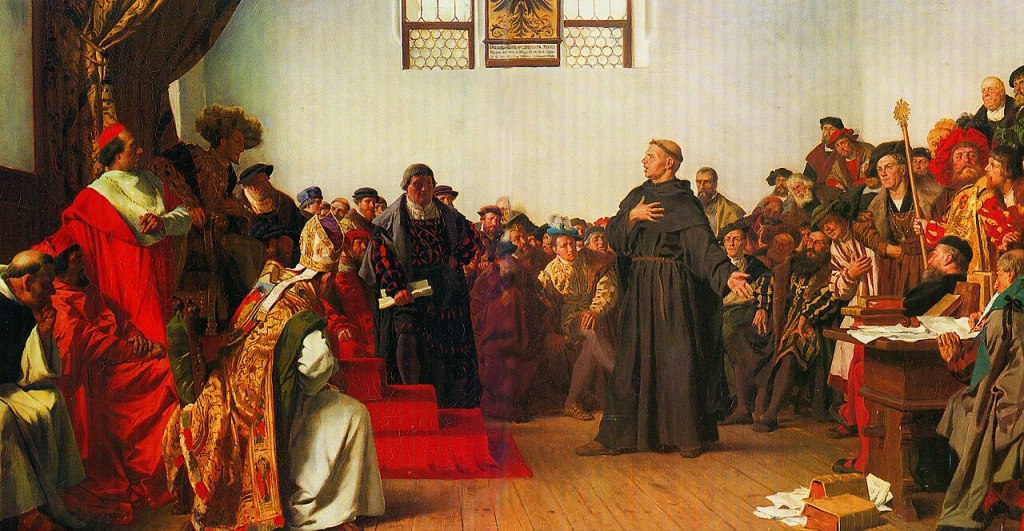
Today we observe Reformation Day! We remember and celebrate the efforts of Martin Luther and other faithful, German catholics in the 16th century who held the line against the Romish churches and their unbiblical additions and developments to Christian doctrine. The church had begun teaching things that are not taught by Jesus and His apostles, things that are not in the Bible, and the reformers said, “No.” For example: indulgences, purgatory, prayers to the saints, complicated systems of penance, the overreaching authority claimed by the Pope, and the rejection of the pure Gospel of salvation by grace alone through faith alone. How did all these errors enter into the church in the first place? Because, like the children in Jesus’ parable, the churches under the Pope rejected the supreme authority of the Word of God. The Roman church today still rejects both the authority and the clarity of the Holy Scriptures,[19] by claiming that the Pope and his bishops alone can authentically and authoritatively interpret the Scriptures.[20] From the Catechism of the Catholic church, paragraph 100: “The task of interpreting the Word of God authentically has been entrusted solely to the Magisterium of the Church, that is, to the Pope and to the bishops in communion with him.”[21] One of these “authentic” and “authoritative” interpretations is that, after initial grace, “we can then merit for ourselves and for others the graces needed for our sanctification, for the increase of grace and charity, and for the attainment of eternal life.”[22] Compare this to our Epistle:
“[F]or all have sinned and fall short of the glory of God, and are justified by his grace as a gift, through the redemption that is in Christ Jesus, whom God put forward as a propitiation by his blood, to be received by faith. This was to show God’s righteousness, because in his divine forbearance he had passed over former sins. It was to show his righteousness at the present time, so that he might be the just and the justifier of the one who has faith in Jesus. Then what becomes of our boasting? It is excluded. By what kind of law? By a law of works? No, but by the law of faith. For we hold that one is justified by faith apart from works of the law.”[23]
Our works do not save us, grace is not some special gift that allows us to earn eternal life for ourselves or others. We are saved by faith in Christ. It is Christ’s atoning blood, we put on Christ’s righteousness, we are baptized into Christ’s death, we are bonded to Christ’s resurrection, and God has mercy on us for Christ’s sake alone. The Lutheran Reformation returns to this biblical truth: we are saved by grace alone, through faith alone, for the sake of Christ alone, on the basis of Scripture alone… and to God alone be the glory. This is the “eternal Gospel”[24] that Martin Luther proclaimed before the Roman authorities. For this simple, childlike faith he was branded as a heretic and an outlaw.
If childlike faith is characterized by relying on Jesus Christ,
then childish faith is characterized by relying on yourself.
Childish faith gives us no comfort and no peace.
Childlike faith comforts us with a peace that surpasses all understanding.
The true Gospel is surprising and offensive and under attack by false churches and teachers… even still today. A professor at Concordia Seminary poses this question based on the Gospel reading: “Who is able to tell God how He should save us? Who can tell God this is the way it should look? Or to use the metaphor in that little parable, who calls the tune that God has to dance to? And if it doesn’t look like this then it can be called into question or even rejected.”[25]
Only the inspired, inerrant, authoritative, clear, and awesome Word of God can do that. Childlike faith clings to this Word of God in faith, and childish faith is no faith at all.
In the name of Jesus. Amen.
May the peace of God, which surpasses all understanding, guard your hearts and your minds in Christ Jesus unto faith everlasting. Amen.
[1] Matthew 19:13-15
[2] Matthew 18:1-6
[3] Matthew 11:16-17
[4] Matthew 3:1-2, John 1:6-8
[5] Luke 1:15
[6] Matthew 3:4
[7] Matthew 11:18
[8] Matthew 3:2
[9] Matthew 3:8
[10] Romans 3:19-24
[11] Matthew 11:5
[12] Matthew 5:1-12
[13] Matthew 1:21
[14] Matthew 9:14-17
[15] John 2:1-11
[16] Matthew 9:10-13
[17] Matthew 9:9-13; 21:31-32; Luke 7:36-50
[18] Matthew 11:19
[19] “What Christians Need to Hear Heading into 2027 | Bryan Wolfmueller,” YouTube video, On the Line, accessed October 24, 2026, https://www.youtube.com/watch?v=jFbZfQiaBMA.
[20] Catechism of the Catholic Church, 2nd ed. (Vatican City: Libreria Editrice Vaticana, 1997), § 85, https://www.vatican.va/archive/ENG0015/__PM.HTM.
[21] Catechism of the Catholic Church, 2nd ed. (Vatican City: Libreria Editrice Vaticana, 1997), § 100, https://www.vatican.va/archive/ENG0015/__PN.HTM.
[22] Catechism of the Catholic Church, 2nd ed. (Vatican City: Libreria Editrice Vaticana, 1997), § 2010, https://www.vatican.va/archive/ENG0015/__P70.HTM
[23] Romans 3:23-28
[24] Revelation 14:6-7
[25] Oschwald, Jeffrey, “Matthew 11:12-19” (2013). Matthew. 37. https://scholar.csl.edu/lalmt/37