What is Jesus Doing with Sinners?

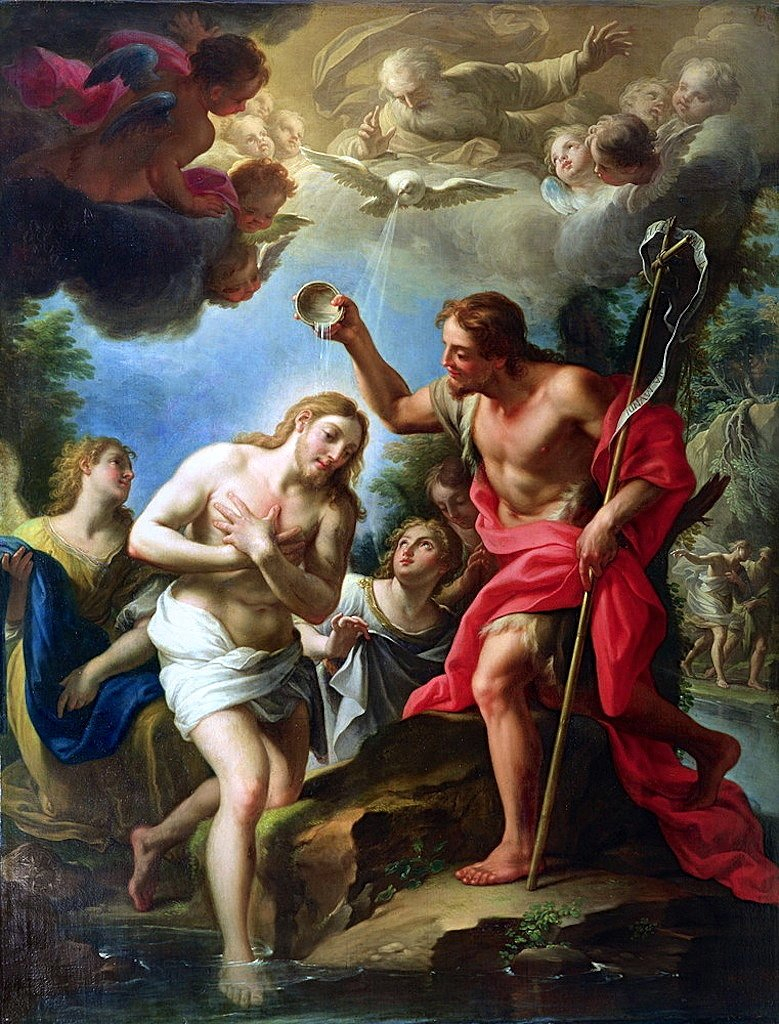
Francesco Trevisani: English: John the Baptist baptizing Christ

WORSHIP VIDEO LINK (linked after 10:45 AM Service)

WORSHIP AUDIO LINK

SERMON AUDIO LINK

BULLETIN

SERMON TEXT BELOW

The Baptism of Our Lord
Immanuel Lutheran Church, Hamilton, Ohio
Pastor Kevin Jud
January 11, 2026
Isaiah42:1-9, Romans 6:1-11, Matthew 3:13-17

Sermons online: 
Text and Audio:         immanuelhamiltonchurch.com   click “sermons”
Text:                           pastorjud.org   
Audio:                         pastorjud.podbean.com 
itunes:                         bit.ly/pastorjud
Full Service Audio:    bit.ly/ImmanuelWorship

            Sometimes parents can get concerned if their children get together with those below their social class.  In the early part of the 1900s there was a young lady whose father had made a fortune in meatpacking and retired at the age of 36.  His daughter was raised in a life of luxury with servants to cook and clean and help with any menial tasks.  At 19, this young lady fell in love with a 25-year-old, penniless army lieutenant.  Her father was worried that this poor soldier was not good enough for his refined, high society daughter.  He told her that if she married him she would not have daddy’s money as a safety net, and she would have to live in army housing and pinch pennies to make ends meet. She married him anyway and learned to cook and clean and stretch the budget.  Her father did not want her to marry a man with no money because he believed that was beneath his daughter’s dignity.  In this case, her father was wrong.  It turned out that the young lieutenant, Dwight Eisenhower, eventually became a five star general and president of the United States.  Mamie Eisenhower chose love for the poor soldier over money and a life of ease.  Life was not easy, but it did bring her to the White House.  Mamie’s father probably should not have been so worried, but it is common for parents to be concerned about their children getting together with those who might be a negative influence.

            Did your parents ever warn you about playing with certain kids because they were afraid those kids might get you into trouble?  I may have been the one the other parents warned about.

            Did your parents ever encourage you to make friends with “good” kids instead of the “bad” kids?  It is not a terrible idea.  We live after the fall into sin and we are influenced by those around us.  When students leave Immanuel to go on to high school I encourage them to pick new friends wisely so that their friends will help make them better people.

            In our Gospel reading today we see a Son hanging out with those well below His social status.  This Son is going around with troublemakers; lowlife riff-raff who struggle to do good.  What is His Father going to think about that? 

            John the Baptist has been preaching in preparation for the Son’s arrival, Matthew 3:2 (ESV) 2 “Repent, for the kingdom of heaven is at hand.”  And the people respond and come to John to confess their sins and be baptized with a baptism of repentance.  There is a crowd of people down at the Jordan responding to John’s message of repentance.  But, what kind of people are they who need to repent and confess?  These are people who are not good enough.  These are sinners who need to repent.

            The Son is so much above sinners.  John the Baptist describes Him as… Matthew 3:11 (ESV) 11 “…he who is coming after me is mightier than I, whose sandals I am not worthy to carry….”  John is not worthy to carry His footwear.  The mighty, holy, King is coming to rule His Kingdom.  Jesus arrives at the Jordan from Galilee.  Jesus comes to John’s baptism of repentance.  But this does not make any sense.  Jesus is the holy, sinless, Son of God.  He has nothing to confess.  He does not need to repent. 

            What is going on here?  What is Jesus doing?  Jesus is standing with sinners and being baptized with a baptism of repentance — like a sinner.  What does God, the Father, think about all this?  Matthew 3:16–17 (ESV) 16 And when Jesus was baptized, immediately he went up from the water, and behold, the heavens were opened to him, and he saw the Spirit of God descending like a dove and coming to rest on him; 17 and behold, a voice from heaven said, “This is my beloved Son, with whom I am well pleased.” 

            Jesus is hanging out with the riff-raff and His Father is well pleased.  That is such great good news for you and me – the riff-raff.  Jesus really has come to save sinners.  He stands with sinners and is baptized with them.  Jesus is not going to be led into trouble by others — He will forgive them and lead them out of trouble.

            Jesus standing with sinners is unexpected because John had proclaimed that Jesus is coming in judgment.  Matthew 3:10 (ESV) 10 Even now the axe is laid to the root of the trees. Every tree therefore that does not bear good fruit is cut down and thrown into the fire… Matthew 3:12 (ESV) 12 His winnowing fork is in his hand, and he will clear his threshing floor and gather his wheat into the barn, but the chaff he will burn with unquenchable fire.”  Jesus has arrived, but where is the axe?  Where is the winnowing fork?  Where is the judgment?  Instead Jesus is being baptized with the sinners.  Jesus answers John’s objections… Matthew 3:15 (ESV) 15 … “Let it be so now, for thus it is fitting for us to fulfill all righteousness.”  “Let it be so now.”  Judgment is not yet.  It will come… but not yet.  For now, Jesus is doing His righteous saving work.  For now, Jesus has great mercy on sinners.  Isaiah 42:3 (ESV) 3 a bruised reed he will not break, and a faintly burning wick he will not quench…” Jesus is showing how He will reign as King.  He will rule in humble, saving, service, culminating with being crowned with thorns and enthroned on the cruel cross at Golgotha.  Jesus will live out what the angel told Joseph Jesus’ name meant… Matthew 1:21 (ESV) 21 … you shall call his name Jesus, for he will save his people from their sins.”  Jesus later instructs us how to make followers of Jesus.  Matthew 28:18–20 (ESV) 18 … “All authority in heaven and on earth has been given to me. 19 Go therefore and make disciples of all nations, baptizing them in the name of the Father and of the Son and of the Holy Spirit, 20 teaching them to observe all that I have commanded you. And behold, I am with you always, to the end of the age.”

Jesus stands with sinners.  At His baptism He is literally standing with sinners at the Jordan River.  As the whole nation of Israel reduced to one, Jesus fulfills God’s law and promises.  He takes the place of sinners, and receives the baptism from John that the sinners received. 

            Now, it can be misinterpreted that because Jesus stands with sinners and is baptized with sinners and eats with sinners that He is promoting sin.  People want to believe that because God loves all people that He endorses their sin. But this is completely against what we see here at the Jordan.  Jesus stands with repentant sinners to pay the price of their sin with His own body and blood.  Jesus does not promote sin; He sheds His blood to pay for sin to appease God’s wrath. Paul addresses this in our Epistle reading.  Romans 6:1–2 (ESV) 1 What shall we say then? Are we to continue in sin that grace may abound? 2 By no means! How can we who died to sin still live in it?”  Jesus comes to save sinners.  He comes to take your sin upon Himself and endure the wrath of God in your place.  In your baptism you are connected to Jesus and His savings works.  This is the Father’s plan. 

            This morning we get to (got to) witness a death and a resurrection…right here at the font.  In the waters of baptism, little Johann Pirn will die (died) to sin and will be (was) raised to eternal life in Christ.  Johann will be (was) given the gift of eternal life in Christ and his body will be (is now) a temple of the Holy Spirit.  Johann will be (has been) declared righteous, innocent and blessed because of what Jesus has done for him.  Jesus comes to save sinners including Johann and including you.  Jesus stands with you. 

Jesus stands with you even as you continue to struggle with sin and temptation.  He stands with you as you once again repent of that same stupid sin.  He takes your place and pays your price and gives you His perfection and holiness.  You are connected directly to Jesus in your baptism.  Through His Church, you stay connected to Jesus until you die.  And then, when your spirit has gone to be with the Lord to wait for the Last Day, we will begin your funeral with these words.  Romans 6:3–5 (ESV) 3 Do you not know that all of us who have been baptized into Christ Jesus were baptized into his death? 4 We were buried therefore with him by baptism into death, in order that, just as Christ was raised from the dead by the glory of the Father, we too might walk in newness of life. 5 For if we have been united with him in a death like his, we shall certainly be united with him in a resurrection like his.”

            Unlike some parents, Jesus’ Father does not try to keep Him away from the lowly and troubled – indeed, that is who He has come to save.  As followers of Jesus who are natural born sinners we need to beware of bad influences in life, but we cannot write people off because we think they are too sinful for Jesus.  Jesus calls for all to repent and believe.  Jesus does not come for those who believe they are good enough. Jesus does not come to encourage the high and mighty to be higher and mightier.  Jesus comes to save sinners like you and me.  So declare with confidence along with Johann, “God’s own child I gladly say it.  I am baptized into Christ.”  Amen. 

Who is the greatest?

WORSHIP VIDEO LINK (linked after 10:45 AM Service)

WORSHIP AUDIO LINK

SERMON AUDIO LINK

BULLETIN

SERMON TEXT BELOW

Lent 5 2024
Immanuel Lutheran Church, Hamilton, Ohio
Pastor Kevin Jud
March 17, 2024
Jeremiah 31:31-34, Hebrews 5:1-10, Mark 10:32-45

Sermons online: 
Text and Audio:         immanuelhamiltonchurch.com   click “sermons”
Text:                           pastorjud.org   
Audio:                         pastorjud.podbean.com 
itunes:                         bit.ly/pastorjud
Full Service Audio:    bit.ly/ImmanuelWorship

            When you go to a professional sporting event; a football, baseball, basketball, soccer game or a hockey match, there is that magical moment when you walk through the tunnel into stands of and emerge into a bright new world.  As you sit and look around during the game, ask yourself, “Who is the greatest one there?” The star player, the coach, the celebrity in the sky box?  Who is the greatest?  It is an age old question.

Sometimes it seems that being one of Jesus’ 12 disciples would have been amazing, but being a follower of Jesus is really rough on the 12 disciples. This teacher is like no other and it is hard to keep up with all that He is doing and with all that He is teaching and all that he is saying is going to happen.  He is amazing.  He heals the sick, He raises the dead, He makes the blind see, He feeds thousands with five loaves of bread and a two fish.  The movement that started out so small is growing and growing.  Jesus is the Christ of God, the Messiah, the anointed one who has come to save His people.  His success and influence grows and grows, but then He keeps saying these strange things about what will happen when he goes to Jerusalem.

            Mark 8:31 (ESV) 31 And he began to teach them that the Son of Man must suffer many things and be rejected by the elders and the chief priests and the scribes and be killed, and after three days rise again.”  The first time Jesus says this is right after Peter confesses that Jesus is the Christ.  When Peter hears that people are going to hurt Jesus, Peter declares that he is not going to allow it to happen.  Peter will protect Jesus.  But instead of being grateful for Peter’s care, Jesus rebukes Peter harshly.  Mark 8:33 (ESV) 33 … “Get behind me, Satan! For you are not setting your mind on the things of God, but on the things of man.” 

            The next time Jesus teaches about what is going to happen in Jerusalem is after His transfiguration on the mountain and driving a demon out of a boy.  Mark 9:31 (ESV) 31 …“The Son of Man is going to be delivered into the hands of men, and they will kill him. And when he is killed, after three days he will rise.” 

This time the disciples do not know what to say — so they remain silent.  Although, it seems that as they travel along the road the 12 engage in the age old question, “Who is the greatest?”  Jesus is teaching them the ways of God, but they are clinging to the ways of man and Jesus reprimands them.  Mark 9:35 (ESV) 

35 … “If anyone would be first, he must be last of all and servant of all.” 

            Now, in today’s reading they are on the road to Jerusalem and Jesus tells them a third time, Mark 10:33–34 (ESV) 33 … “See, we are going up to Jerusalem, and the Son of Man will be delivered over to the chief priests and the scribes, and they will condemn him to death and deliver him over to the Gentiles. 34 And they will mock him and spit on him, and flog him and kill him. And after three days he will rise.” 

            This scene is really crazy.  Jesus and the disciples are on the road to Jerusalem and Jesus has said that in Jerusalem they are going to condemn Him, mock Him, spit on Him, flog Him and kill Him.  You do not have to be a genius to figure out how to make this better.  There is an easy answer to this problem.  Just stop.  Stop going to Jerusalem.  Turn around and go the other way.  They are going to kill you in Jerusalem.  Turning around is the plan that makes sense.  But Jesus’ ways are not the ways of the world.  Jesus’ ways do not make sense to the world. 

            So, how do the disciples respond to Jesus’ third description of what is going to happen to Him?  Rebuking Jesus for talking like this did not work.  Being silent did not resolve the tension.  Maybe they should just change the subject.  James and John ask Jesus to do whatever they ask — and what is it they want?  Mark 10:37 (ESV) 37 … “Grant us to sit, one at your right hand and one at your left, in your glory.”  James and John have figured out who is the greatest and it is the two of them.   

            The issue of greatness is an age old problem.  We desperately want other people to know that we are better than them.  In the corporate world there are marks of greatness displayed by those who have achieved success and by those who want to achieve.  You dress for success.  It matters greatly about the brand of your shoes and your wristwatch, the cut of your jacket, the cost of your car, and the color of your credit card.  These things are meant to impress others.  Where you sit at a sporting event shows your status. Are you in the skybox or right behind home plate, or are you way up top in an obstructed view seat?  Your natural, sinful self wants others to see how great you are.  Even after being reprimanded earlier for arguing about who is the greatest, James and John still want everyone to know that they are Jesus’ favorites; they are the greatest.

These two disciples do not comprehend what Jesus is repeatedly saying and He tells them, Mark 10:38 (ESV) 38 … “You do not know what you are asking. Are you able to drink the cup that I drink, or to be baptized with the baptism with which I am baptized?”  The spots to the right and left of Jesus in His glory are already reserved for two lowlifes who will be crucified next to Jesus who has made Himself a lowlife being executed on a cross. 

            Jesus will pray that this cup might pass, but He indeed will drink the cup of God’s wrath.  Jesus will be baptized in his own blood and intense suffering and torment. He will be immersed in God’s wrath as the penalty for the sin of the whole world. 

            Can James and John drink the cup and be baptized with Jesus’ baptism?  They will, but not until Jesus has drunk the cup and been baptized and left the blessing. You also drink the cup and are baptized with Jesus’ baptism.  You drink from Jesus’ cup at the Lord’s Supper.  1 Corinthians 10:16 (ESV) 16 The cup of blessing that we bless, is it not a participation in the blood of Christ?  The bread that we break, is it not a participation in the body of Christ?”  You have been baptized in Jesus baptism.  Galatians 3:27 (ESV) 27 For as many of you as were baptized into Christ have put on Christ.”

            Jesus drank the cup of God’s wrath and He was baptized with suffering and death on the cross.  His cup and baptism are, for you, a cup of blessing and a baptismal blessing, but there is still suffering attached.  To follow Jesus is to take up your cross.  James learns this when he is executed by the sword of Herod Agrippa in 44 AD.  John is grieved by the death of his brother and the other nine disciples executed for the faith.  It is thought that John is the only disciple to have died a natural death, although as an old man he is exiled to the island of Patmos where he receives the vision he records in the book of Revelation. 

            You are a baptized child of God.  You drink from the Lord’s cup of blessing and this marks you as an enemy of the world.  The world hates you because it hates Jesus and you are one with Jesus.  The ways of the world say you should reject Jesus to avoid the hate and the suffering and the self-denial; to avoid the cross.  This is the way of the world, but Jesus teaches, Matthew 5:11 (ESV) 11 “Blessed are you when others revile you and persecute you and utter all kinds of evil against you falsely on my account.”  God’s way is different than man’s way. 

Oh, dearest Jesus, what law hast thou broken?  Jesus broke the law of the world that seeks after personal greatness, power, and glory.  Despite knowing what will happen, Jesus goes to Jerusalem to give His life as the ransom for you.

            Jesus knows that figuring out who is the greatest is the way of the world; declaring your greatness is the way of man.  Self-promotion is the how the world operates but that is not how Christians live.  Mark 10:42–44 (ESV) 42 …“You know that those who are considered rulers of the Gentiles lord it over them, and their great ones exercise authority over them. 43 But it shall not be so among you. But whoever would be great among you must be your servant, 44 and whoever would be first among you must be slave of all.”

            Christianity is radical rebellion against the culture. To be great is to be a servant to others.  As you enter the stadium remember the greatest at the sporting event is not the star player, not the coach, not the celebrity, but rather perhaps the security guard or the person grilling the hamburgers or the one sweeping the stands afterward.  Christian greatness is very different.  It is a very different life to be a Christian — humbly serving others instead of promoting yourself. 

            Jesus’ life on earth was a life of serving others culminating in the ultimate service of giving His life in exchange for yours. Mark 10:45 (ESV) 45 For even the Son of Man came not to be served but to serve, and to give his life as a ransom for many.”  

            Oh, dearest Jesus, what law hast thou broken?  Jesus broke the law of the world that seeks after personal greatness, power, and glory.  Despite knowing what will happen, Jesus goes to Jerusalem to give His life as the ransom for you.

            The people of the world know how to avoid the difficulties and suffering of the cross.  They reject the cross and they are left in their sin.  Jesus comes to earth for the very purpose of going to the cross to save you. Contrary to everything that makes sense, Jesus gives Himself for you.  The Lord of the Universe is your servant.  Take up your cross and follow Him.  Amen. 

Baptism: Clean or Messy?

WORSHIP VIDEO LINK (linked after 10:45 AM Service)

WORSHIP AUDIO LINK

SERMON AUDIO LINK

BULLETIN

SERMON TEXT BELOW

Baptism: Clean or Messy?
Vicar Matthew Kinne
Texts: Mark 1:4-11; Romans 6:1-11

Back in November I witnessed the baptism of eight students from our day school. It was moving to see these young people drawn to the font by faith. But I will say, it was also very messy. As each student leaned over the font, Pastor Jud would scoop out water and drench their heads while proclaiming that these children are baptized in the triune name of the Father, Son, and Holy Spirit. While some of the water fell back into the font, a healthy portion of the water rolled off the side and onto the stone floor. By the time all eight baptisms were completed, most of the water was no longer in the font. The scene showed that something messy happened here.

When we think about baptism, we usually think of something elegant and clean. The color white is often used to show the righteousness and purity God offers to the baptized. Sins are washed away and the name of Christ is put on. A burning candle is lit to show the world that the light of Christ is now in this believer. The new life of the baptized is started. It all seems clean on our end. But what about to God? Is baptism clean or messy from His point of view?

Let’s begin with the man who baptizes Jesus. In our Gospel reading, we hear John proclaiming a baptism of repentance for the forgiveness of sins. Nothing seems clean about his ministry. For starters, he preaches in the wilderness. According to the custom of the Jews the only sacred and holy place to preach was in the temple in Jerusalem or in local synagogues. John is in the wilderness where wild animals roam and where everything unclean resides. He wears camel hair, and he eats locusts and wild honey. Not only does the man look messy, but he is also baptizing in the muddy waters of the Jordan River. Nothing about what John is doing seems sanitary, yet despite the lack of cleanliness, people believe John’s teachings. Our text says in verse five, “And all the country of Judea and all Jerusalem were going to him and being baptized by him in the river Jordan, confessing their sins.”(Mark 1:5).

Somehow the preaching of John lures so many people into the water. Something about John was different that makes people confident God is working through him to forgive sins. Yet his ministry confuses the temple officials. 

Later in Mark, Jesus rides into Jerusalem on a donkey, which is the beginning of His passion walk to the cross.  At the temple Jesus is tested by the scribes and priest. They asked Jesus, “By what authority are you doing these things, or who gave you this authority to do them?” Jesus said to them, “I will ask you one question; answer me, and I will tell you by what authority I do these things. Was the baptism of John from heaven or from man?” (Mark 11:28-31) After much discussion, and fear of being hated by the Jews, they answer Jesus saying, “We do not know,” (Mark 11:33). 

The temple officials are blind to what John’s baptism is teaching. They think that this immersion in the Jordan is nothing more than a scam to ruin their business. They are scared that John is taking away their customers and putting their temple up for foreclosure. They would essentially be out of a job.

 These blind priests and scribes do not realize that this man, John, is the last of the Old Testament prophets. The clothes John wears are the same clothes worn by the men before him who proclaimed God’s word to all nations about the coming Messiah. The food John eats, though a seemingly odd diet, is food provided by God in the wilderness. This is similar to how God provided meat for Elijah at the Kerith Ravine, east of the Jordan River nearly 900 years earlier (1 Kings 17). 

Not only is John’s lifestyle similar, but his message is also the same. Jonah proclaimed to the city of Nineveh, “‘Yet forty days, and Ninevah shall be overthrown!And then the people believed in God and repented of their evil ways” (Jonah 3).  When Jeremiah was commanded by the Lord to prophecy to King Jehoiakim the son of Josiah, king of Judah, he said, “Thus says the LORD: If you will not listen to me, to walk in my law that I have set before you, and to listen to the words of my servants the prophets whom I send to you urgently, though you have not listened, then I will make this house like Shiloh, and I will make this city a curse for all the nations of the earth,’” (Jeremiah 26:4-6). Just like Elijah, Jeremiah, and Jonah and all the other prophets, John’s message is, “Repent, for the Messiah comes!”  And like many prophets before him John suffers imprisonment and death.        

Yet even though the prophets, including John, suffer many afflictions and sometimes even death for preaching God’s truth, none of what they suffer compares to the pain and hardships Christ would suffer through His baptism. Before Jesus is baptized, He is already clean. He is God. He doesn’t carry any sin with him into the water. The message of John, “Repent and be baptized” seems obsolete as there is nothing to wash away. But if we remember what the will of God is throughout the Old Testament it makes a lot of sense. 

God had to send His Son to earth so that there would be a sacrifice large enough to atone for all the sins of the world. When the heavens open at Jesus’ baptism, the Holy Spirit comes down and the voice of the Father thunders from heaven saying, “You are my beloved Son, with you I am well pleased!” This voice from the Father is not just a “hey son, I’m proud of you” like some dads may say after their son’s team wins a basketball game. This word pleased points out that this body of Jesus, that was just washed in the Jordan, came out of the water ready to take on the wrath of the Father and be a sacrifice for all. God provides this sacrifice to save His creation from the bondage of death. In baptism Jesus puts on your sin, my sin, the disciples’ sin, the prophets’ sin, the sin of all people, and He takes it to the cross. This baptism makes Jesus’ life and death messy and miserable.

Throughout His ministry, Jesus gets His hands dirty. After He is baptized, He goes out to be tempted by Satan in the wilderness while never sinning once. His first disciples come from low social classes. His first miracle in Mark is healing a man with an unclean spirit. He heals many others with diseases, eats dinner with criminals, gets called out by the temple staff for being a hypocrite, and is arrested. He is then beaten, spat on, mocked, and killed. Yet, while all this is happening to Him, He knows that He suffers these things for all men. He dies even for the ones who are putting Him to death. There is nothing clean about what Jesus has to do by taking on the Father’s will. 

            His baptism, that ends with His death, is the only way He could make you clean. The will of the Father is completed when you are washed clean in the blood of Jesus at your baptism.  In baptism you are united with Christ in His death, yet the work of the Son is not done if Christ stays dead. St. Paul writes, “For if we have been united with him in a death like his, we shall certainly be united with him in a resurrection like his.” (Romans 6:5). If we only hear that Christ died there would be no hope for life eternal. He went through all this messiness of death on a cross to make atonement for the sins the world and then rises out of the depths of death three days later to life. This is the work that pleases the Father. This is the work that fixes the gap between us and God. 

            When the baptized pray, “Thy Kingdom Come” and we eat of that body and drink of that blood in His Supper, we get a glimpse of the unity of heaven and earth. We look forward to the day of the resurrection of the dead when we will forever be in His presence, and we will never again be lost to the messiness of this world. Jesus did the dirty work for you, so that you could be washed whiter than snow. He completed the work of the Prophets, took on all sin, and freely gives you His living water of everlasting life. He has chosen you, saved you and set you free! You are clean in the blood of Jesus Christ. Amen.