WORSHIP VIDEO LINK (linked after 10:45 AM Service)
WORSHIP AUDIO LINK
SERMON AUDIO LINK
BULLETIN
SERMON TEXT BELOW
Nineteenth Sunday After Pentecost
Immanuel Lutheran Church, Hamilton, Ohio
Vicar Daniel English
October 19, 2025
Proper 24 C – Genesis 32:22-30; 2 Timothy 3:14-4:5; Luke 18:1-8
Sermons online:
Text and Audio: immanuelhamiltonchurch.com click “sermons”
Text: pastorjud.org
Audio: pastorjud.podbean.com
itunes: bit.ly/pastorjud
Full Service Audio: bit.ly/ImmanuelWorship
Are You the Israel of God?
Remember that really big mistake that you made all those years ago? That foolish thing you said, that faithless thing you did? Just the thought of it sinks your heart into your stomach for shame. What is left in the wake of your foolishness? – anger and broken relationships. Now you think it’s best to just forget about it. Live your life, move on, let bygones be bygones. If only back then you had the wisdom and maturity that you have now.. things would have gone so much differently… you today would have done things very differently than you back then.. And everybody would understand that, wouldn’t they? You can’t take it back, as much as you’d like to, you can’t change what you’ve done.. Maybe you can forget about it and just go on with your life. But now, you’ve just been told that the one person who knows best what you’ve done is on his way right now to meet with you. What does he want? What does he have to say to you? Is he angry? Can you possibly be forgiven? Our Old Testament lesson today is about one such man as you, Jacob.
Jacob is coming out of the land of Haran and he’s stopped at the Jabbok River, a tributary of the Jordan. He has just learned that his brother, Esau, is coming to meet him with 400 men. Jacob is greatly afraid and distressed. He’s greatly afraid and distressed because he last saw his brother, Esau, moments after stealing Esau’s blessing from their father, Isaac – a blessing of grain and wine, a blessing of strength and leadership, the very blessing from God passed down from Abraham to Isaac… a blessing that Isaac intended for his firstborn son, Esau. Jacob tricks his father, Isaac, into blessing him instead, and Esau is left to receive a much inferior blessing, “Behold, away from the fatness of the earth shall your dwelling be, and away from the dew of heaven on high. By your sword you shall live, and you shall serve your brother; but when you grow restless you shall break his yoke from your neck” (Genesis 27:39b-40). This is a blessing nearly opposite to the blessing that Jacob had received. It sounds more like a curse than a blessing. Jacob and Esau’s relationship was always characterized by struggle, right from the beginning when they shared a womb, but this was the breaking point. Esau swears, “I will kill my brother Jacob” (Genesis 27:41b). Esau’s vow to kill his brother Jacob are the last words Scripture records Esau speaking up to this point. Jacob flees in fear of his brother’s wrath to his mother’s hometown of Haran. He doesn’t return until 20 years later, and now he is going to come face-to-face with his past… face-to-face with his brother and his brother’s army of 400 men.
“Greatly afraid and distressed” (Genesis 32:7). This is how the Holy Spirit describes Jacob in this moment, greatly afraid and distressed. All those years ago he crossed the river with nothing but his staff, and now, he prepares to cross back over with many servants, oxen, donkeys, flocks… with his two wives and his eleven sons. Jacob looks over his many blessings and considers the cost he will have to pay. What of all this that the Lord has given to him, will the Lord see fit to take away? He splits his belongings into two camps. “If Esau comes to attack the one camp,” he thinks, “then the other camp can escape” (Genesis 32:8). Jacob is distressed… and greatly afraid.
Fear and distress! If you can believe it, this is the beginning of the most precious gift that God gives to Jacob. This is the blessed contrition that precedes justification. This is a gift from the Holy Spirit. Jacob prays, “O God of my father Abraham and God of my father Isaac, […] I am not worthy of the least of all the deeds of steadfast love and all the faithfulness that you have shown to your servant. […] Please deliver me from the hand of my brother, from the hand of Esau, for I fear him, that he may come and attack me, the mothers with the children. But you said, ‘I will surely do you good, and make your offspring as the sand of the sea, which cannot be numbered for multitude’” (Genesis 32:9-12). What has happened here? The man who once thought himself worthy enough of his father’s blessing to steal it from his brother, now considers himself unworthy of even the least of all the things that God has done for him. And yet, he still seeks good from God. Why? Because God has promised to do good to him… to be gracious and merciful to Jacob, a sinner. This is the gift of repentance and faith. When you look at your own works, by faith you see only what it is that got you into the mess that you’re in. When you pray for the Lord to forgive and deliver you, you know that “[you] are neither worthy of the things for which [you] pray, nor have [you] deserved them, but [you] ask [your Father in heaven] that He would give them all to [you] by grace, for [you] daily sin much and surely deserve nothing but punishment” (Luther’s Small Catechism, Lord’s Prayer, Explanation Fifth Petition).
What else can Jacob do? Jacob arranges for gifts of animals to be sent to his brother, Esau. Goats, and rams, and camels, and cows, and donkeys. Jacob thinks, “I may appease [Esau] with the present that goes ahead of me, and afterward I shall see his face. Perhaps he will accept me” (Genesis 32:20b). Like Jacob, you can fall into the temptation of trying to make satisfaction for your sins. To try to appease the Lord you arrange for offerings to go ahead of you: your prayer and devotion… your money and your service. What need does the mighty hunter, Esau, the commander of the Edomite army, have for Jacob’s train of animals? And what need does the Almighty God, the Ancient of Days and the King of the Universe, have for all your works and effort? What can you possibly do to appease the wrath of God?
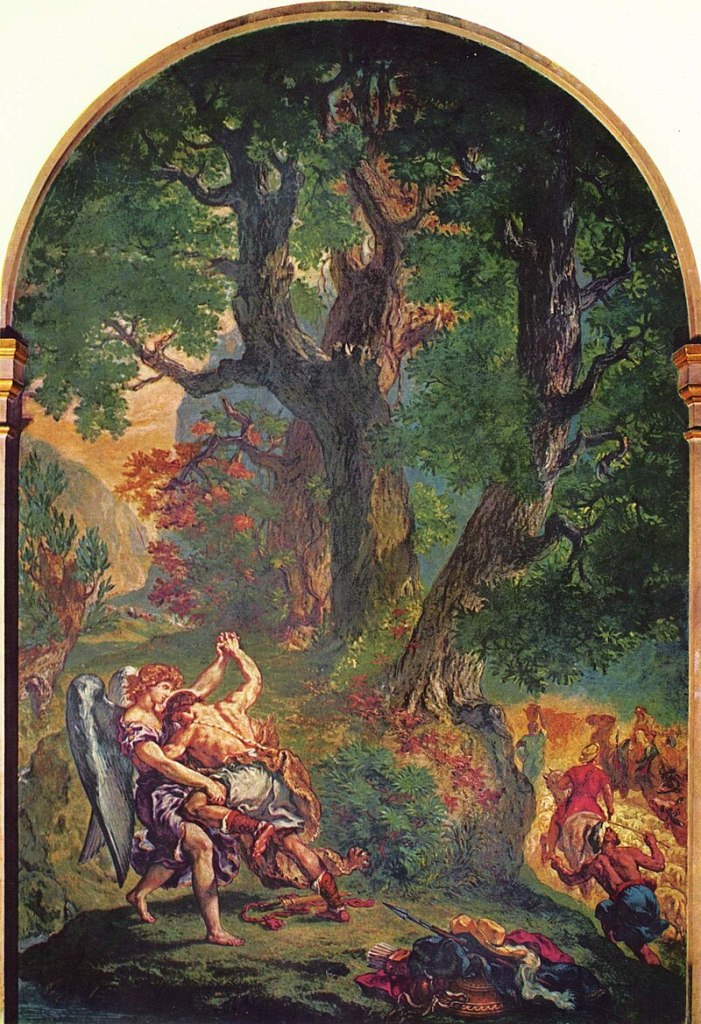
Before Jacob sees the face of Esau, he meets Another face-to-face, and here is where our Old Testament reading begins. Jacob sends his family across the ford of the Jabbok River and stands alone, separated from all that he has. Left alone, distressed and greatly afraid, this is where Jacob is encountered by the preincarnate Christ. Jacob will later say of this encounter, “I have seen God face to face, and yet my life has been delivered” (Genesis 32:30b). The text reads, “And Jacob was left alone. And a man wrestled with him until the breaking of the day” (Genesis 32:24). Jacob wrestles with our Lord until the next morning. Our Lord puts Jacob’s hip socket out of joint, but Jacob doesn’t let go. Jacob is convicted of his sins… he knows he is unworthy, and yet he has been given the faith that looks only to the Word and Promise of God for salvation. Jacob says to our Lord, “I will not let you go unless you bless me” (Genesis 32:26b). And then, like his father’s father, Abraham, the Lord blesses Jacob with a new name.
You know the name…, “Israel.” It comes from the Hebrew roots SARAH: to contend, strive, or persist… and EL: God. God gives this name to Jacob to commemorate his striving with Him there on the banks of the Jabbok river, but also to mark Jacob as one who has graciously been given the privilege to wrestle with God, to fervently seek – and receive – forgiveness and blessing from the Lord.
By inspiration of the Holy Spirit, the name “Israel” will be uttered by the prophets, the psalmists, the evangelists, and the apostles over 2,500 times. The name that was initially given to one man, Jacob, will eventually refer to his children, then to a nation of his offspring, and in the fullness of time the promise and blessing given to Israel is fulfilled in the person of Jesus Christ. Now, through the one man, Jesus Christ, Israel – as you know it – has come to refer to Christ’s Church… to all believers… to you. Paul writes to the Romans: “[N]ot all who are descended from Israel belong to Israel, and not all are children of Abraham because they are his offspring […] [I]t is not the children of the flesh who are the children of God, but the children of the promise are counted as offspring” (Romans 9:6-8). And to the Corinthians: “For all the promises of God find their Yes in [Jesus Christ]” (2 Corinthians 1:20).
The next morning, as Jacob limped along, he saw Esau coming, his 400 men with him. “Esau ran to meet [Jacob] and embraced him and fell on his neck and kissed him, and they wept” (Genesis 33:4). Jacob discovered that Esau had no need for his gifts; he and his men were not set on battle. Instead, they were a convoy of grace and mercy and peace.
So, what can you possibly do to appease the wrath of God? What can you do to avoid his righteous punishment? One day you will stand before the Lord Christ, the Almighty and Righteous Judge, He is the one who knows best all that you have done in thought, and word, and deed. And on that day you will see that He does not condemn you. On that day you will see that the devil is a liar. All your foolish and faithless deeds were forgiven long ago. Christ, with His holy, precious blood and with His innocent suffering and death, has purchased and won you from all sins, from death, and from the power of the devil. You were baptized, you were sealed with the name of the Triune God and all of your sins are washed away. Repent and believe the Gospel, you are the Israel of God, “[a]nd he [has] redeem[ed] Israel from all his iniquities” (Psalm 130:8). “Peace be upon Israel” (Psalm 125:5b). In the Name of Jesus. Amen.

 From the Pulpit