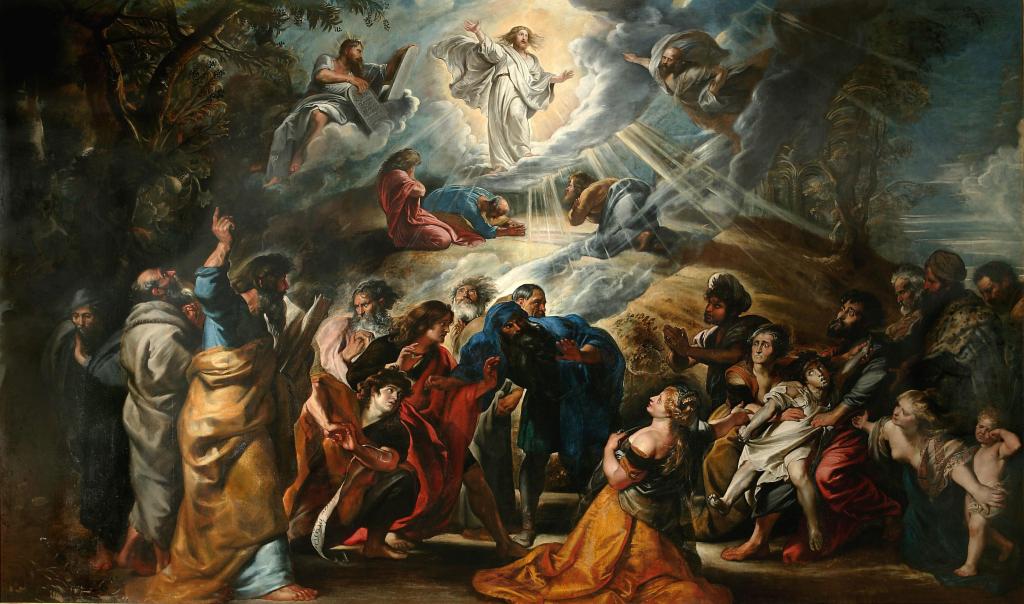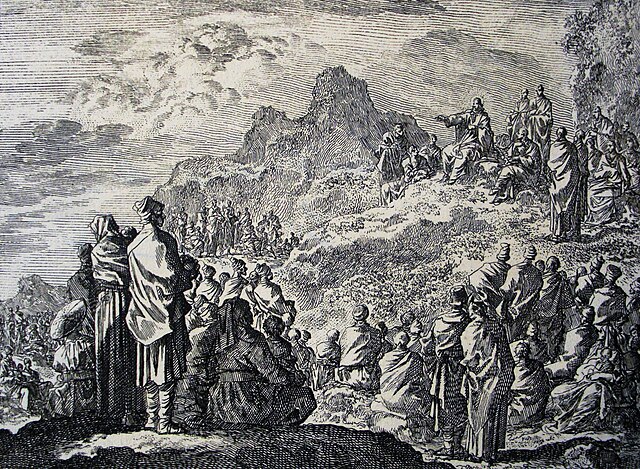
The Sign of the Cross

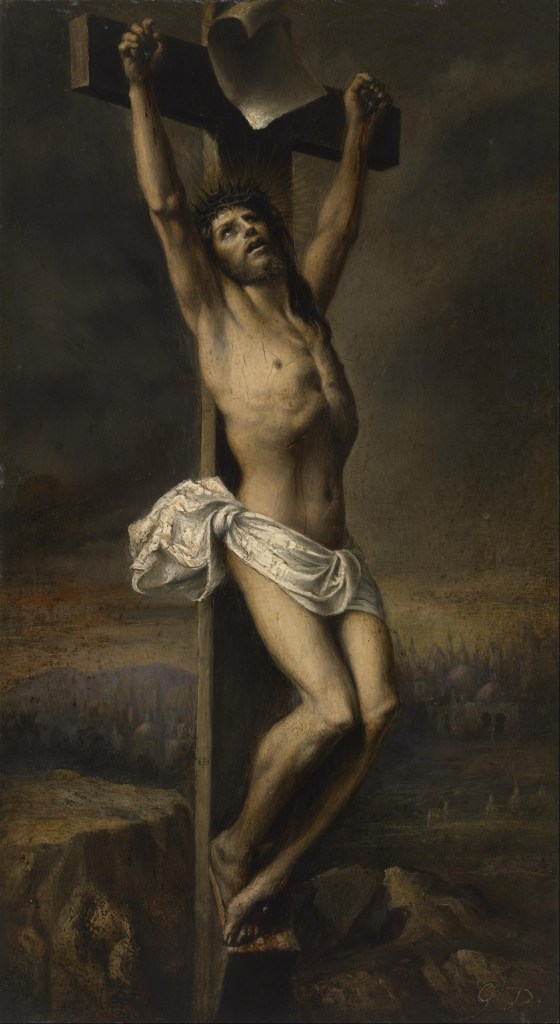
Gustave Doré – Christ on the Cross

WORSHIP VIDEO LINK 

WORSHIP AUDIO LINK

SERMON AUDIO LINK

BULLETIN

SERMON TEXT BELOW

Daniel English 
April 3, 2026
Sermon – Good Friday
Isaiah 52:13-53:12; Psalm 22; Hebrews 4:14-16; 5:7-9; John 19:17-30; John 18:1-19:42;

The Sign of the Cross

In the Name of the Father, and of the Son, and of the Holy Spirit. Amen.

This is it. This is what Christianity is all about. “[Jesus] was pierced for our transgressions; he was crushed for our iniquities; upon him was the chastisement that brought us peace, and with his wounds we are healed… [H]e poured out his soul to death and was numbered with the transgressors; yet he bore the sin of many, and makes intercession for the transgressors.”[1] These words were written by the Prophet Isaiah approximately 700 years before the birth of Christ.[2] This is the event for which God’s people were waiting. This is the central event of all history, of all eternity.

Tonight we remember the Crucifixion of our Lord Jesus Christ. We ponder the cross. The cross is the ultimate symbol of Christianity. As I began, I spoke the Name of the Triune God, and some of you made the sign of the cross. On Ash Wednesday, you received an ashen cross upon your forehead. Before Pastor Jud reads from the Holy Gospel, he makes the sign of the cross on his lips and his heart. When we bring our young children to the rail during the Sacrament of the Altar, they receive the sign of the cross on their foreheads to remind them of their baptism —the day when they received the sign of the cross on their foreheads and their hearts to mark them as one redeemed by Christ the crucified. At the beginning of the Divine Service, we pro-cess behind a depiction of Jesus on the cross, and we end services with a benediction accompanied by the sign of the cross. More than a few of you probably wear a cross around your neck. The cross is everywhere. Even in traditions that have done away with almost every other kind of Christian symbol, sculpture, or artwork, they will still have the cross. The ubiquity of this symbol isn’t new. Of course it began with the crucifixion, but by the second century Christians are recorded as wearing out their foreheads with the sign of the cross, making it “at every forward step and movement, at every going in and out… in all the ordinary actions of daily life.”[3] We often sing in the beautiful hymn, Abide with Me, “Hold thou Thy cross before my closing eyes;”[4] The cross is ours, and nobody can take it from us… but when was the last time you really beheld the cross of Christ? Good Friday —the most somber holy-day of the year— forces us to remember that the cross is where Christ’s body was hung to die, and it is only by Christ’s body being there that the cross has any power at all.

Whenwe behold the cross of Christ, we see the gory death of our Lord. And by His death we are shown the seriousness of our sin. — Therefore, the cross is a sign of repentance and holy fear. — In the cross of Christ, we also see the Father’s great love for us. “God sent his only Son into the world, so that we might live through him.”[5] — So the cross is also a sign of hope and love. — The cross of Christ is where Jesus’ side is pierced, and out come the blood and the water. The cross is where Jesus gives His Body and sheds His Blood for our eating and drinking, and the water that flows from His riven side is the Water of Life, the very source of our baptismal waters. — The cross is, finally, a sign of forgiveness and salvation.

Repentance and Holy Fear

The Crucifixion is gruesome and it’s bloody. Even before the Crucifixion, Jesus is beaten by Caiaphas and his council. After being turned over to the Roman authorities, Jesus’ beating continues. A crown of thorns is pressed into His head, and Jesus is scourged with a metal-tipped whip. Now, the six hour long crucifixion is just beginning. Isaiah prophetically describes Jesus during His Crucifixion, “his appearance was so marred, beyond human semblance, and his form beyond that of the children of mankind.”[6] Jesus’ physical damage is so severe that He is hardly recognizable. This torture is paired with the climax of His spiritual agony as Jesus is forsaken by the Father. This is not the way you would expect any man to be treated, much less the Son of God. As the Psalmist prophesies, Jesus is treated like a worm, not a man.[7] On the cross, Jesus becomes and is treated as the worst of all sinners. Luther writes, “And all the prophets saw this, that Christ was to become the greatest thief, murderer, adulterer, robber, desecrator, blasphemer … [that] there has ever been anywhere in the world. He is not acting in His own Person now. Now He is not the Son of God, born of the Virgin. But He is a sinner, who has and bears the sin of Paul, the former blasphemer, persecutor, and assaulter; of Peter, who denied Christ; of David, who was an adulterer and a murderer, and who caused the Gentiles to blaspheme the name of the Lord (Rom. 2:24). In short, He has and bears all the sins of all men in His body – not [because] he has committed them but [because, out of love,] He took these sins, committed by us, upon His own body, in order to make satisfaction for them with His own blood.”[8] On the cross, Jesus bears the sin that so easily entangles you. We see the wrath of the Father poured out on Christ as He bears the punishment we justly deserve. “What Thou, my Lord, hast suffered Was all for sinners’ gain; / Mine, mine was the transgression, But Thine the deadly pain. / Lo, here I fall my Savior! ‘Tis I deserve Thy place; / Look on me with Thy favor, And grant to me Thy grace.”[9]

Hope and Love.

All for sinners’ gain… It’s in the “why” of Christ’s Crucifixion that something so gory and so awful becomes something so gracious and wonderful. Jesus Christ died on the cross for you. Jesus Christ suffered the punishment for your sin so you wouldn’t have to. Jesus Christ died to save you… He died to reconcile you to the Father and to make Himself your brother, so that you would become a co-heir with Him of Eternal Life. “For the human mind the death of Christ on the cross naturally [seems] to be utmost confusion and wretchedness, not the glorious salvation event it really [is]. But a Christian knows better in spite of tears, sorrow, pain, and death.”[10] By the Holy Spirit’s work through your Baptism, through the Word, and through the sustaining Holy Supper… you know better. You know that Christ’s death on the cross is your eternal life. “God the Father, driven by His loving will, sends [Jesus] His Word through which He creates the world. [We are] not simply ejected from creation… God’s Word became flesh in Jesus Christ, the first missionary, through whom God the Father is reconciled to [us].”[11] And we to Him.

Forgiveness and Salvation

Now, with eyes of faith we behold the Crucifixion with awe and wonder. The Crucifixion is even… beautiful. The dispensation of this beautiful exchange from the cross is what Christianity is all about. Our sin in exchange for Christ’s righteousness, the punishment we deserve in exchange for a full pardon, the death of our mortal flesh in exchange for everlasting life. Having heard of these things, do you want them? Is this an exchange you desire to be made? My brothers and sisters in Christ, they are yours by faith… and faith is a gift from the cross. After Jesus died, a soldier “pierced his side with a spear, and at once there came out blood and water.”[12] From the cross, Jesus, the Lamb of God, gives His Body for you to eat. From the cross, Jesus sheds His Blood for you to drink. And in the eating and drinking you receive strengthened faith and the forgiveness of sins. From the cross, Jesus pours out the baptismal waters so that you can be washed. And in the washing you receive faith and the righteousness of Christ. Jesus does all this so that you can hear the Word of God and believe it. Doesn’t it make sense now why we lift high the cross and hold it before us everywhere we go? Upon waking, before eating, while praying. The cross is the emblem of your salvation!

Suffering for a Time

The cross is also the emblem of your suffering. You, Christians, are partakers of the cross, joined to Christ by His very Body and Blood. Through your baptism you are bonded to the death of Jesus, but your baptism also binds you to His resurrection, “[f]or if we have been united with him in a death like his, we shall certainly be united with him in a resurrection like his. We know that our old self was crucified with him in order that the body of sin might be brought to nothing.”[13] “[G]rief, torment, and pain will continue [in this life]. Spiritual trials, struggles of conscience, sorrow, and anguish must also occur. The heart must be smitten by terror; the old man must be destroyed. Struggles with unbelief, indignation against God, [and] even despair plague the Christian because [w]e often cannot see the will of God and His counsel in time of suffering.”[14] Behold… our cross.

“Luther’s advice is clear: Be still; let God rule. Thank God that He has given you the word and the promise. …fix [your] eyes and… [your] mind on the word alone, on baptism, on the Lord’s Supper, … on absolution.”[15] On His cross.

And so we look to the crucified and risen Lord Jesus Christ, and we pray: “Be Thou my consolation, [O Lord,] My shield, when I must die; / Remind me of Thy passion When my last hour draws nigh. / Mine eyes shall then behold Thee, Upon Thy cross shall dwell, / My heart by faith enfold Thee. Who dieth thus dies well.”[16]

In the Name of Jesus. Amen.

And now may the peace of God, which surpasses all understanding, guard your hearts and minds in Christ Jesus unto life everlasting, until He returns in glory. Amen.


[1] Isaiah 53:5, 12b

[2] Edward A. Engelbrecht, ed., Lutheran Bible Companion, Volume 1: Introduction and Old Testament (St. Louis: Concordia Publishing House, 2014), 715.

[3] Tertullian, “The Chaplet, or De Corona,” in Ante-Nicene Fathers, Vol. 3, ed. Alexander Roberts and James Donaldson (Buffalo, NY: Christian Literature Publishing Co., 1885), Chap. 3, ccel.org.

[4] “Abide with Me,” in Lutheran Service Book (St. Louis: Concordia Publishing House, 2006), 878, st. 6.

[5] 1 John 4:9b

[6] Isaiah 52:14b

[7] Psalm 22:6

[8] Martin Luther, Lectures on Galatians, 1535, Chapters 1-4, vol. 26 of Luther’s Works, ed. Jaroslav Pelikan and Helmut T. Lehmann (St. Louis: Concordia Publishing House, 1963), 277.

[9] “O Sacred Head, Now Wounded,” in Lutheran Service Book (St. Louis: Concordia Publishing House, 2006), Hymn 449, st. 1.

[10] Heino O. Kadai, “Luther’s Theology of the Cross,” in Concordia Theological Quarterly Vol 63, no. 3 (July 1999): 193.

[11] Klaus Detlev Schulz, Mission from the Cross: The Lutheran Theology of Mission (St. Louis: Concordia Publishing House, 2009), 93 (emphasis mine).

[12] John 19:34b

[13] Romans 6:5-6a

[14]  Heino O. Kadai, “Luther’s Theology of the Cross,” in Concordia Theological Quarterly Vol 63, no. 3 (July 1999): 194.

[15] Kadai, “Luther’s Theology of the Cross”: 194.

[16] “O Sacred Head, Now Wounded,” st. 4.
Like Barrabbas: Guilty but Freed by Christ

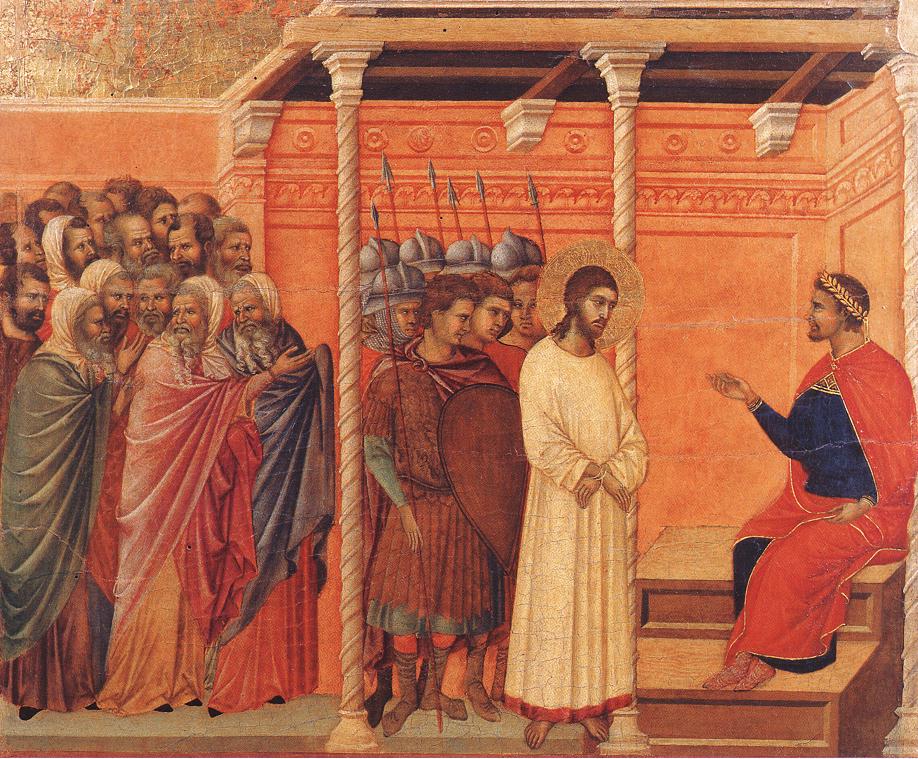
Duccio di Buoninsegna – Christ Before Pilate Again

WORSHIP VIDEO LINK 

WORSHIP AUDIO LINK

SERMON AUDIO LINK

BULLETIN

SERMON TEXT BELOW

Daniel English
March 11, 2026
Sermon – Lent 5 – Midweek Wednesday
Isaiah 53:4-7; Matthew 27:1-26;

Like Barabbas: Guilty but Freed by Christ

In the Name of the Father, and of the Son, and of the Holy Spirit. Amen.

“When morning came.”[1] In case we would forget as we turn the page from the 26th chapter of Matthew’s Gospel to the 27th, these words remind us that Jesus has been struck, spit on, slapped, and mocked all night. After the Last Supper with His disciples the night before —the Last Supper before His death— Jesus is betrayed and arrested —falsely arrested— while praying in the Garden of Gethsemane on the Mount of Olives.[2] Jesus is beaten and abused by Caiaphas and his council after they conduct a sham trial and falsely convict Him.[3] Jesus is betrayed by one… and abandoned by the rest of his disciples, including, finally, by Peter.[4] Jesus has had a very long night. This is where our Gospel reading begins. Morning breaks and the Son of Righteousness rises to be bound, and led away, and delivered over to Pilate in order that He be sentenced to death.[5]

As the light of day exposes the sinful works of man, God’s Word gives us three, negative examples from which we can learn. Three examples of what NOT to do. First, the betrayer, Judas, who is in deep despair over his sins to the point of taking his own life. Judas is sorry for his sins —he has contrition— but he does not have faith in God’s mercy and forgiveness. Second, the governor, Pontius Pilate, who denies justice and rejects the truth for the sake of his own personal safety and success. Pontius Pilate does not believe that Jesus is guilty or deserving of death —he has conviction— but he lacks the courage to do what is right. Third, the chief priests, the elders, and the crowds who demand that Jesus be crucified. They are envious and wrathful. They are blind to who Jesus is and blind to their own sin. The actions of these three, Judas, Pontius Pilate, and the crowds result in the release of a notorious criminal, Barabbas, while our Lord Jesus Christ is sent off to die. But what these three meant for evil, God meant for good.

There isn’t much good at all that can be said about Judas Iscariot. He is an unbelieving[6] thief[7] who agrees to betray Jesus in exchange for 30 pieces of silver.[8] Even Jesus calls him “a devil.”[9] Judas receives his plan to betray Jesus from the devil himself.[10] But even Judas, when he sees that Jesus is condemned, is filled with regret. He doesn’t even want the money he received as a reward. As he tries to return it he says, “I have sinned by betraying innocent blood.”[11] Judas has contrition, but he doesn’t have faith. The reformers knew very well that proper repentance consists of two parts: contrition and faith (Ap XIIa 1).[12] It is not enough for a person to know and regret his sin. In his Meditation on Christ’s Passion, Luther writes, “After man has thus become aware of his sin and is terrified in his heart, he must watch that sin does not remain in his conscience, for this would lead to sheer despair… Therefore beware, lest you do as those perverse people who torture their hearts with their sins and strive to do the impossible, … [to] get rid of their sins by running from one good work … to another… if you … presume to still your conscience with your contrition and penance, you will never obtain peace of mind, but will have to despair in the end.”[13] And this is exactly what Judas does. He is in such despair that he takes his own life. When you are convicted of your sin, don’t wallow in your guilt like Judas. This only leads to despair. Instead, look to Jesus in faith and see His loving heart. Martin Luther continues, “We know God [rightly] when we grasp him not in his might or wisdom… but in his kindness and love. Then faith and confidence are able to exist, and then man is truly born anew in God.”[14]

Pontius Pilate is the governor of Judea. He is a Roman ruler serving under emperor Tiberius in an area predominately populated by Jews. Judea is a difficult province to govern. Various Jewish sects: the Pharisees, the Sadducees, the Zealots, the Yahad, and the Hellenized Jews are all in tension with one another,[15] not to mention conflict with the Samaritans and Gentiles in the neighboring regions. Now the Jews seemingly come together in agreement: Jesus is causing problems, and he needs to be killed. Pilate is amazed by Jesus’ silence in response to the false charges brought before him,[16] he understands that Jesus has been delivered up out of envy,[17] and he doesn’t find Jesus guilty of any crime deserving death.[18] Jesus is innocent, and Pontius Pilate knows that Jesus is innocent… but he doesn’t have the courage to stop his crucifixion. To prevent Jesus’ death would risk public unrest that could mean the end of his political career or even his life. Foolishly, Pontius Pilate fears those who kill the body but cannot kill the soul. His encounter with the Word made flesh does not yield fruit, but —like a sprout with no root or choked out by thorns— he chooses to declare himself innocent in one moment, then scourges Jesus and delivers him over to be crucified in the next.[19] It is true, we are not justified by our good works, and so Pilate having courage wouldn’t have saved him, but we can’t “imagine a kind of faith that can exist and abide with, and alongside of, a wicked intention to sin and to act against conscience. But after a man has been justified through faith, then a true living faith works by love (Ep III 11).”[20] Instead of cowering like Pilate, we are to hold fast to the faith and encourage one another to love and good works.[21]

Finally, the chief priests and the elders with the crowd they persuaded to destroy Jesus. It would be hard to believe that this crowd could be the same people who just a week ago on Palm Sunday shout, “Hosanna to the Son of David! Blessed is he who comes in the name of the Lord! Hosanna in the highest!”[22] Whether fickle followers of Jesus or a hand-picked crowd by the Jewish elites[23], we see a disturbing showing of the depths of human evil. It had become a regular custom for Pilate to release a prisoner at the feast of Passover. The crowd is given the choice between Jesus, an innocent man, and Barabbas, a notorious criminal. The crowd presses for Barabbas to be released, and for Jesus to be put to death. “Pilate saw that he was gaining nothing, but rather that a riot was beginning, he took water and washed his hands before the crowd, saying, ‘I am innocent of this man’s blood; see to it yourselves.’ And all the people answered, ‘His blood be on us and on our children!’”[24] The irony. “His blood be on us and on our children.” If only the crowds understood the power of Jesus’ blood they would cry out instead, “Deliver me from bloodguiltiness, O God, O God of my salvation, and my tongue will sing aloud of your righteousness.”[25] The chief priests, the elders, and the crowds present at Jesus’ trial before Pilate are spiritually blind. They are spiritually dead. They are the final negative example set before us in today’s reading, and they choose a criminal Barabbas to be released instead of the perfect Lamb of God. But what they meant for evil, God meant for good.

The Scriptures in many places invite the reader to imagine himself as part of the Biblical narrative. Maybe you see yourself in the Israelites as they are rescued by David’s courageous and decisive victory over Goliath, fearful and reticent the Israelites wait on David to do what they are unable to do[26]… just as we wait on the Lord Jesus Christ to do what we are unable to do. Maybe you see yourself in the unnamed disciple with Cleopas on the Road to Emmaus as Christ unveils Himself in the Old Testament, slow to understand and believe the two disciples feel their hearts burning within them as they learn from the Lord until they finally come to know Him in the breaking of the bread[27]… just as our understanding and faith deepen by the Power of the Holy Spirit working through the Word and is sustained and strengthened at the Lord’s Supper. Maybe in Joseph’s brothers as they receive forgiveness from Joseph so surprising that they can hardly believe it is real… just as we hear from Pastor an absolution of all our sins that sounds too good to be true, but it is true. In today’s reading, I invite you to see yourself in Barabbas… a sinner… imprisoned, unworthy, and guilty. And yet, Christ suffers death on the cross and Barabbas is released, free and uncondemned.

Luther calls this the “wonderful exchange.” “That is the mystery which is rich in divine grace to sinners: wherein by a wonderful exchange our sins are no longer ours but Christ’s, and the righteousness of Christ is not Christ’s but ours. He has emptied Himself of His righteousness that He might clothe us with it, and fill us with it. And He has taken our evils upon Himself that He might deliver us from them… in the same manner as He grieved and suffered in our sins, and was confounded… we rejoice and glory in His righteousness.”[28]

Be sorry for your sins, but don’t stop there and despair. Have faith in Jesus for deliverance… Believe in the righteousness, and innocence, and blessedness of Jesus, but don’t stop there. Have the courage to live out your convictions in love toward God and one another… Do not be spiritually blind, refusing to see your own sin or to know who Jesus is, but repent and believe the Gospel.

“For all have sinned and fall short of the glory of God, and are justified by his grace as a gift, through the redemption that is in Christ Jesus, whom God put forward as a propitiation by his blood, to be received by faith. This was to show God’s righteousness, because in his divine forbearance he had passed over former sins. It was to show his righteousness at the present time, so that he might be just and the justifier of the one who has faith in Jesus.”[29]

We all are like Barabbas… guilty… but freed by Christ. In Christ, we are innocent and free.

In the Name of Jesus. Amen.


[1] Matthew 27:1a

[2] Matthew 26:20-29; 26:36-55;

[3] Matthew 26:57-68

[4] Matthew 26:69-75

[5] Matthew 27:1-2

[6] John 6:63-64

[7] John 12:4-6

[8] Matthew 26:14-16

[9] John 6:70-71

[10] Luke 22:1-6; John 13:2

[11] Matthew 27:4

[12] McCain, Paul Timothy et al., eds. Concordia: The Lutheran Confessions; A Reader’s Edition of the

Book of Concord. 2nd ed. St. Louis: Concordia, 2006.

[13] Martin Luther, “A Meditation of Christ’s Passion,” in Luther’s Works, Vol. 42: Devotional Writings I, ed. Jaroslav Jan Pelikan, Helmut T. Lehmann, and Christopher Boyd Brown (Philadelphia: Fortress Press, 1969), 6–14.

[14] Ibid. 

[15] Bryan Stecker, “Episode Three – Understanding the Jewish Religion with Jacob Benson,” November 13, 2023, YouTube video, 0:42:59, https://www.youtube.com/watch?v=-Z_HzijjDq4.

[16] Matthew 26:14

[17] Matthew 27:18

[18] Luke 23:4, 22

[19] Matthew 27:24-26

[20] McCain, Paul Timothy et al., eds. Concordia: The Lutheran Confessions; A Reader’s Edition of the

Book of Concord. 2nd ed. St. Louis: Concordia, 2006.

[21] Hebrews 10:23-25

[22] Matthew 21:9

[23] Maier, Paul L., “Commentary: The Most Overlooked Verse in the Bible,” Reporter, February 5, 2007, https://reporter.lcms.org/2007/commentary-the-most-overlooked-verse-in-the-bible/.

[24] Matthew 27:24-25

[25] Psalm 51:14

[26] 1 Samuel 17

[27] Luke 24:13-35

[28] Luther, Martin. Werke (Weimar, 1883), 5:608

[29] Romans 3:23-26

What is better than eternal life?

WORSHIP VIDEO LINK (linked after 10:45 AM Service)

WORSHIP AUDIO LINK

SERMON AUDIO LINK

BULLETIN

SERMON TEXT BELOW

Lent 5 2026
Immanuel Lutheran Church, Hamilton, Ohio
Pastor Kevin Jud
March 22, 2026
Ezekiel 37:1-14, Romans 8:1-11, John 11:1-45

Sermons online: 
Text and Audio:         immanuelhamiltonchurch.com   click “sermons”
Text:                           pastorjud.org   
Audio:                         pastorjud.podbean.com 
itunes:                         bit.ly/pastorjud
Full Service Audio:    bit.ly/ImmanuelWorship

            Survivor is an interesting show.  People voluntarily endure miserable conditions, lack of sleep, severe lack of food and primitive hygiene.  Why do they do it?  In hopes of a $1 million prize.  It is said that everyone has their price.  Normally you would not do something, but for enough money you would. 

            What would it take for you to give up eternal life with Jesus?  How much would be enough?  After Jesus raises Lazarus from the dead, the chief priests and the Pharisees are faced with this dilemma.  John 11:47–48 (ESV) 47 …“What are we to do? For this man performs many signs. 48 If we let him go on like this, everyone will believe in him…”  

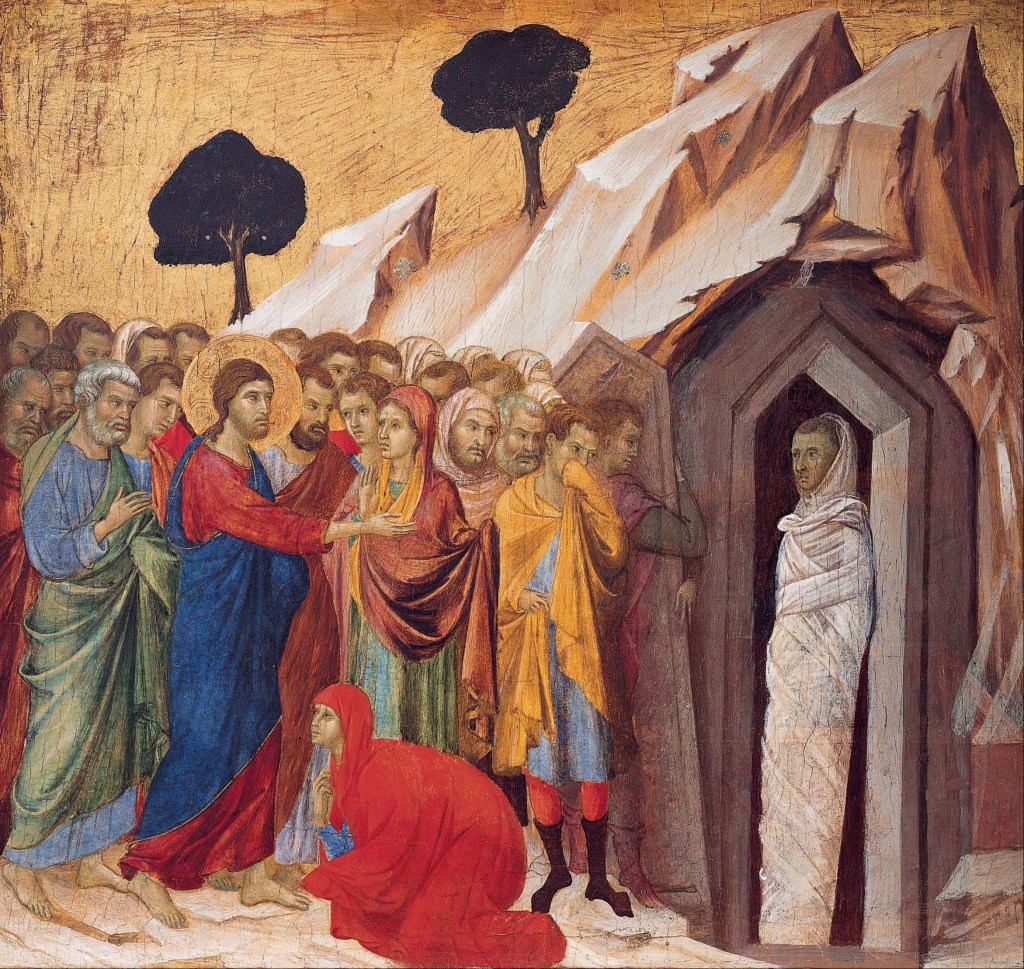
            A little earlier, in Jerusalem, Jesus restored sight to a man born blind, but there was some confusion as to what took place, Jesus made mud with saliva and anointed a man’s eyes, and that man went off to wash and someone came back who could see, but did it really happen?  The religious leaders sowed confusion and doubt.  But now Jesus has raised a man from the dead who has been dead for four days.  And this was not done quietly, there was a crowd of people standing outside the tomb when Jesus had the stone rolled back and He shouted at a dead man, “Lazarus, come out!”  And Lazarus came out.  Jesus has authority over blindness, and also over death.

            What Jesus has done will cause many to believe in Him and Jesus has taught repeatedly that whoever believes in Him has eternal life. John 3:16 (ESV) 16 “For God so loved the world, that he gave his only Son, that whoever believes in him should not perish but have eternal life.  John 3:36 (ESV) 36 Whoever believes in the Son has eternal life…  John 6:40 (ESV) 40 For this is the will of my Father, that everyone who looks on the Son and believes in him should have eternal life, and I will raise him up on the last day.”  Just before raising her brother Lazarus, Jesus told Martha, John 11:25–26 (ESV) 25 … “I am the resurrection and the life. Whoever believes in me, though he die, yet shall he live, 26 and everyone who lives and believes in me shall never die…” 

            Word of Jesus’ promise of eternal life to all who believe in Him has certainly made it to the Jewish leaders.  That with the fact that Jesus just healed a blind man and raised a man from the dead is causing great anxiety.  While they do not want to accept it, the Jewish leaders know that Jesus has the power of God.  What would be so valuable to them that they would choose it over Jesus and the promise of eternal life?

            John 11:47–48 (ESV) 47 …“What are we to do? For this man performs many signs. 48 If we let him go on like this, everyone will believe in him, and the Romans will come and take away both our place and our nation.”  Caiaphas and the others are afraid that if more people believe in Jesus it could cause trouble and the Romans will replace the Jewish leaders with others friendlier to the Romans.  They are worried they could lose their jobs.  Their jobs…or eternal life?  They are likely not thinking about it in quite that way, but that is what is at stake.

            Jesus has been warning the Pharisees and other Jewish leaders to repent and follow Him.  When the Pharisees come to Galilee to question Jesus and His disciples about breaking their handwashing rules Jesus rebukes them.  Matthew 15:7–9 (ESV) 7 You hypocrites! Well did Isaiah prophesy of you, when he said: 8 “ ‘This people honors me with their lips, but their heart is far from me; 9 in vain do they worship me, teaching as doctrines the commandments of men.’”  Now, Jesus has come to Jerusalem and He is causing no end of trouble and everything seems to spinning out of control.  Wiser heads need to prevail.  Someone needs to restore calm.  Caiaphas declares to the Jewish leaders… John 11:49–50 (ESV) 49 …“You know nothing at all. 50 Nor do you understand that it is better for you that one man should die for the people, not that the whole nation should perish.”  Caiaphas thinks he is going to kill Jesus in order to save his own position, but what Caiaphas is doing as High Priest is selecting the final sacrificial Lamb to die for the sins of all people.  Caiaphas’ words as High Priest are in line with the will of God.  Indeed, it is better that one man should die for the people rather than all the people perish. Caiaphas declares this not just as a leader, but as God’s High Priest.  Now, Caiaphas rejects the Messiah, he has forgotten God’s mercy, he teaches that salvation is through following hundreds of rules, but he still holds the office of High Priest.  As High Priest Caiaphas prophesies John 11:51–52 (ESV) 51 …that Jesus would die for the nation, 52 and not for the nation only, but also to gather into one the children of God who are scattered abroad.”  Caiaphas may also be prophesying God’s truth when he announces to the Jewish leaders who reject Jesus, “You know nothing at all.”

            The Jewish leaders reject eternal life in order to try to save their positions.  They are willing to kill the one who makes the blind see and raises the dead.  Still today, there is a great temptation to reject eternal life in order to protect something else.  What would be more important than eternal life with Jesus? Some reject eternal life in order to be friends with the world.  People reject the true Jesus and make up their own Jesus in order to fully embrace whatever new perversion comes along that twists God’s good gifts.  People make up a Jesus who celebrates sexual immorality and the sacrifice of unborn children on the altar of sexual freedom.  They make up a Jesus who continually evolves to keep promoting ever-changing immorality.

            People give up eternal life with Jesus in order to pursue, financial success, or athletic success or academic success.  They reject the true Jesus who died for their sins in exchange for a “life-coach Jesus” who helps them build their self-esteem and achieve their goals.  I fear many people have given up eternal life with Jesus because they want to have a lazy Sunday morning.   

            In our easily offended society, there is a temptation to reject belief in the true Jesus who is the way, the truth and the life, and the only way to the Father, in exchange for a Jesus who is at peace with false teachers and false religions.  Their new Jesus is not the way; he is just way.  People give up eternal life in order to not offend anyone. 

            Folks give up the true Jesus who pays the price for natural born sinners who cannot save themselves, in exchange for a Jesus that has you earn salvation so you can find dignity in your works. 

            There is great temptation to give up belief in Jesus so you can indulge your pride, your lust, your greed, your anger, your right to get even. There is a powerful desire in each of us to mold a new Jesus in our image instead of being conformed to the Word of God.

What would it take for you to give up eternal life with Jesus?         Jesus gives the free gift of forgiveness and eternal life to all who believe in Him through the Holy Spirit.  You have the real Jesus.  Rejoice in the real Jesus who restored sight to the blind and raised the dead and who delivers to you forgiveness, life and salvation in the waters of Holy Baptism, in the Word of God, in Jesus’ words of absolution, and in the Body and Blood of your Savior in Holy Communion. 

            The world looks at Jesus’ means of delivering grace and scoffs at the humble simplicity of water, words, bread and wine.  You rejoice.  You know that Jesus is the one who died for the people and rose from the dead to conquer sin and death and give you eternal life.

            Caiaphas and the Jewish leaders know nothing at all. You have eternal life in Jesus.  There is nothing… not even life itself, more valuable than that.  What would it take for you to give up eternal life with Jesus?  Nothing. You have the greatest gift ever given. You live the humble life of a repentant sinner who knows you cannot save yourself, and who knows that you have been saved by the love of God through the blood of Jesus. 

            At confirmation I ask the question, “Do you intend to continue steadfast in this confession and Church and to suffer all, even death, rather than fall away from it?  The confirmands answer, “I do, by the grace of God.”  In the face of the tremendous temptation to give up on Jesus for something else, I ask you, “Do you intend to continue steadfast in this confession and Church and to suffer all, even death, rather than fall away from it?”  If so, answer, “I do, by the grace of God.”

            You have the greatest treasure possible.  You have faith in Jesus given you by the Holy Spirit. You believe in Jesus.  You have eternal life.  Amen. 

There is darkness, there is light. There is blindness there is sight.

WORSHIP VIDEO LINK (linked after 10:45 AM Service)

WORSHIP AUDIO LINK

SERMON AUDIO LINK

BULLETIN

SERMON TEXT BELOW

Lent 4 2026
Immanuel Lutheran Church, Hamilton, Ohio
Pastor Kevin Jud
March 15, 2026
Is 42:14-21, Ephesians 5:8-14, John 9:1-41

Sermons online: 

Text and Audio:         immanuelhamiltonchurch.com   click “sermons”
Text:                           pastorjud.org   
Audio:                         pastorjud.podbean.com 
itunes:                         bit.ly/pastorjud
Full Service Audio:    bit.ly/ImmanuelWorship

            A couple weeks ago we heard about the Pharisee, Nicodemus, coming to Jesus at night to find out more about this new teacher.  Jesus teaches him about being born from above by water and the spirit and that God loved the world, in this way, that He sent His only son that whoever believes in Him should not perish but have eternal life. Jesus concludes His teaching with Nicodemus… John 3:19–21 (ESV) 19 And this is the judgment: the light has come into the world, and people loved the darkness rather than the light because their works were evil. 20 For everyone who does wicked things hates the light and does not come to the light, lest his works should be exposed. 21 But whoever does what is true comes to the light, so that it may be clearly seen that his works have been carried out in God.” 

            There is darkness and there is light.  Jesus is the light.  John 1:4–5 (ESV) 4 In him was life, and the life was the light of men. 5 The light shines in the darkness, and the darkness has not overcome it.”

            There is darkness and there is light.  There is blindness and there is sight.  In our Gospel reading, Jesus leaves the temple after the Jews want to stone him for saying John 8:58 (ESV) 58 …“Truly, truly, I say to you, before Abraham was, I am.”  “I am”, is God’s name.

            John 9:1 (ESV) 1 As [Jesus] passed by, he saw a man blind from birth.”  Being born blind is a great disability; at Jesus’ time and today. While some progress is being made, still, with all our medical advances, there is no cure for someone born blind.

            The disciples do not talk to the man, but they talk about him.  There is a common belief that suffering is retribution from God for specific wrongdoing.  The disciples want to know who sinned, this man, or his parents.  John 9:3–5 (ESV) 3 Jesus answered, “It was not that this man sinned, or his parents, but that the works of God might be displayed in him. 4 We must work the works of him who sent me while it is day; night is coming, when no one can work. 5 As long as I am in the world, I am the light of the world.” 

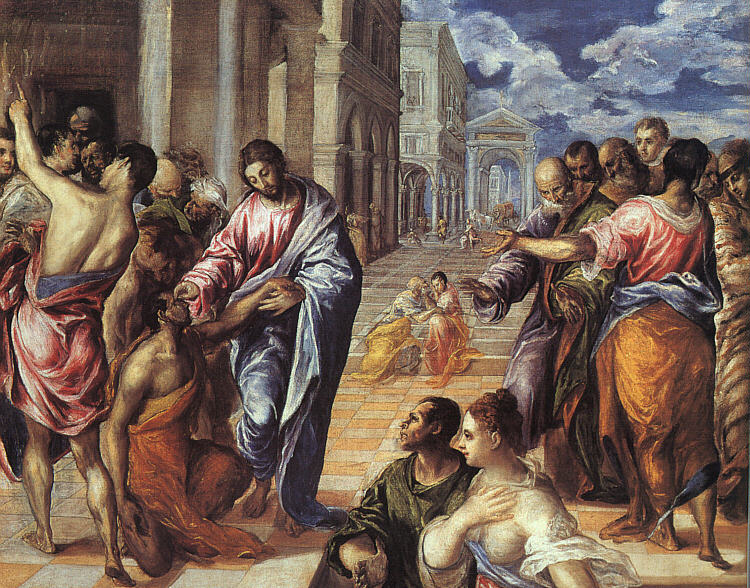
            Jesus spits on the ground and makes mud with the saliva and anoints the man’s eyes and tells him, “Go wash in the pool of Siloam.” The man does what he is told, he goes to the pool south of the Temple Mount washes the mud off, and comes back seeing. A man, blind from birth, can now see. This is an incredible miracle of God. No one else can make the blind see.  Jesus is the real deal.  Isaiah prophesied, Isaiah 35:5 (ESV) 5 Then the eyes of the blind shall be opened…”

            The formerly blind man is well known.  Everyone has seen him sitting outside the temple begging. Now it is clear that the man who was blind can now see, but, trying to discredit Jesus, they dispute that it is really him. They question the man and he replies, John 9:11 (ESV) 11 … “The man called Jesus made mud and anointed my eyes and said to me, ‘Go to Siloam and wash.’ So I went and washed and received my sight.” The man can physically see; spiritually his eyes are beginning to open.  He describes the healer as, “The man called Jesus.”

            The man is questioned by the Pharisees who dispute among themselves whether someone who broke one of their abundant Sabbath rules by making a tablespoon of mud could be from God — even though He did a miracle that only God can do.  When asked, “What do you say about Him,” the man answers, “He is a prophet.”  The man is being enlightened.

            After his parents refuse to say how their son was healed, for fear of being thrown out of the synagogue, the Jews question the man again about what happened.  They go back and forth and the man boldly proclaims, John 9:32–33 (ESV) 32 Never since the world began has it been heard that anyone opened the eyes of a man born blind. 33 If this man were not from God, he could do nothing.”  The formerly blind man’s spiritual eyes are widening and he confesses that Jesus is from God.

            Unable to win on the facts, the Pharisees switch to an ad hominin attack, John 9:34 (ESV) 34 … “You were born in utter sin, and would you teach us?” And they cast him out. The Pharisees do not want the truth…they do not want a reminder of the truth… they reject the miracle…they reject the Messiah who showed His authority over blindness… they reject the light.

            John 9:35–38 (ESV) 35 Jesus heard that they had cast him out, and having found him he said, “Do you believe in the Son of Man?” 36 He answered, “And who is he, sir, that I may believe in him?” 37 Jesus said to him, “You have seen him, and it is he who is speaking to you.” 38 He said, “Lord, I believe,” and he worshiped him.” The man has physical sight and now the man can spiritually see.  He calls Jesus, “Lord,” and he worships Him.  The man was in the darkness, but now he is in the light.  He was blind, but now he sees. 

            John 9:39 (ESV) 39 Jesus said, “For judgment I came into this world, that those who do not see may see, and those who see may become blind.”  The man born blind can now see — physically and spiritually.  He is living in the light of Christ.  He is one of those who do not see who may see.  Who then are they who see who may become blind?  John 9:40 (ESV) 40 Some of the Pharisees near him heard these things, and said to him, “Are we also blind?” 

            Jesus answer is a bit confusing, John 9:41 (ESV) 41 Jesus said to them, “If you were blind, you would have no guilt; but now that you say, ‘We see,’ your guilt remains.”  The man born blind initially does not know who Jesus is, but the light of Christ shines on him and he begins to understand, and then understand even more, and confesses Jesus is Lord.  The Pharisees believe they know the scriptures, but they are blind.  They are so corrupted in their understanding that instead of rejoicing with a man born blind who can now see, they obsess over Jesus making mud on the Sabbath, and they kick the healed man out of the synagogue for not condemning Jesus.

            There is darkness and there is light.  There is blindness and there is sight.  Jesus is the light.  The light rescues you from darkness.  As Paul writes to the Colossians… Colossians 1:12–14 (ESV) 12 [give] thanks to the Father, who has qualified you to share in the inheritance of the saints in light. 13 He has delivered us from the domain of darkness and transferred us to the kingdom of his beloved Son, 14 in whom we have redemption, the forgiveness of sins.”  And to the Ephesians….Ephesians 5:8 (ESV) 8 for at one time you were darkness, but now you are light in the Lord. Walk as children of light…”  

            There is darkness and there is light.  There is blindness and there is sight.  It is as simple and complex as that.  Jesus is the light.  Jesus rescued you from the darkness and now you are a child of light.  This morning we get to witness God rescuing Johann and Hannah from the darkness and bringing them into the Kingdom of light through water and the Spirit.  They were in darkness, but now they are light in the Lord. They were blind, but now they see.

            Jesus is the light.  Jesus is the only light.  There is no other light.  If you seek a way other than Jesus, you are walking in darkness.  If you seek a way other than Jesus you are blind. 

            Jesus is the light.  The light shines in the darkness.  The light has come to save all people but not everyone believes in the light. Far too many love the darkness rather than the light because their works are evil and they do not want their works to be exposed.  Those doing evil want to stay in the dark.

            We think of light as good, but the light can hurt. When you walk into the brightness of sunlight from a dark room you have to shield your eyes.  Coming out of the darkness of sin, the light of Christ can cause pain.  The light exposes the darkness of your sin.  The light convicts you of your sin.  The light shows that you are, by nature, spiritually blind, dead and an enemy of God.  The light shows your helplessness.  Many reject the light because the light causes them pain and exposes their evil. They reject the light before they can be enlightened as to who Jesus is and what He has done for them. 

Jesus is the light.  The light takes on Himself the darkness of the world and is suffocated by the darkness on the cross.  That dark Friday it seems the light has been extinguished.  But the light dawns again Sunday morning.  The light conquers the darkness by rising from the dead.  Jesus takes your darkness and gives you His light so, with the man who had been blind from birth, you confess, “Jesus is Lord!” and you worship Him. 

There is darkness and there is light.  There is blindness and there is sight.  Jesus is the light.  You are light in Him.  You were blind, but now you see.  Amen. 

Jesus is Alone

WORSHIP VIDEO LINK 

WORSHIP AUDIO LINK

SERMON AUDIO LINK

BULLETIN

SERMON TEXT BELOW

Lent Wednesday 3 2026
Immanuel Lutheran Church, Hamilton, Ohio
Pastor Kevin Jud
March 4, 2026
Matthew 26:30-56

Sermons online: 
Text and Audio:         immanuelhamiltonchurch.com   click “sermons”
Text:                           pastorjud.org   
Audio:                         pastorjud.podbean.com 
itunes:                         bit.ly/pastorjud
Full Service Audio:    bit.ly/ImmanuelWorship

            Jesus and the eleven disciples leave the upper room and walk down the east side of Mt. Zion toward the Kidron Valley.  It appears they are headed back to Bethany on the Mount of Olives where they have been staying while in Jerusalem.  On their way, Jesus warns them, Matthew 26:31 (ESV) 31 … “You will all fall away because of me this night. For it is written, ‘I will strike the shepherd, and the sheep of the flock will be scattered.’” He also gives them great hope.  Matthew 26:32 (ESV) 32 But after I am raised up, I will go before you to Galilee.”  The disciples do not understand what is happening even though Jesus has told them over and over.  Before His transfiguration…Matthew 16:21 (ESV) 21 … Jesus began to show his disciples that he must go to Jerusalem and suffer many things from the elders and chief priests and scribes, and be killed, and on the third day be raised.”  Peter rejected this idea and rebuked Jesus.  Matthew 16:23 (ESV) 23 But [Jesus] turned and said to Peter, “Get behind me, Satan! You are a hindrance to me. For you are not setting your mind on the things of God, but on the things of man.”  In Matthew Jesus tells them twice more what will happen, but as it is happening they do not understand. 

            Jesus has made it clear that He is going to Jerusalem and He will be seized and killed and raised from the dead.  He tells the disciples that they will all fall away that night, but Peter insists, “Not me.”  Matthew 26:33 (ESV) 33 … “Though they all fall away because of you, I will never fall away.”  Jesus tells Peter that he is going to deny Jesus three times before the rooster crows and Peter rejects this, vehemently.  Matthew 26:35 (ESV) 35 …“Even if I must die with you, I will not deny you!” And all the disciples said the same.”

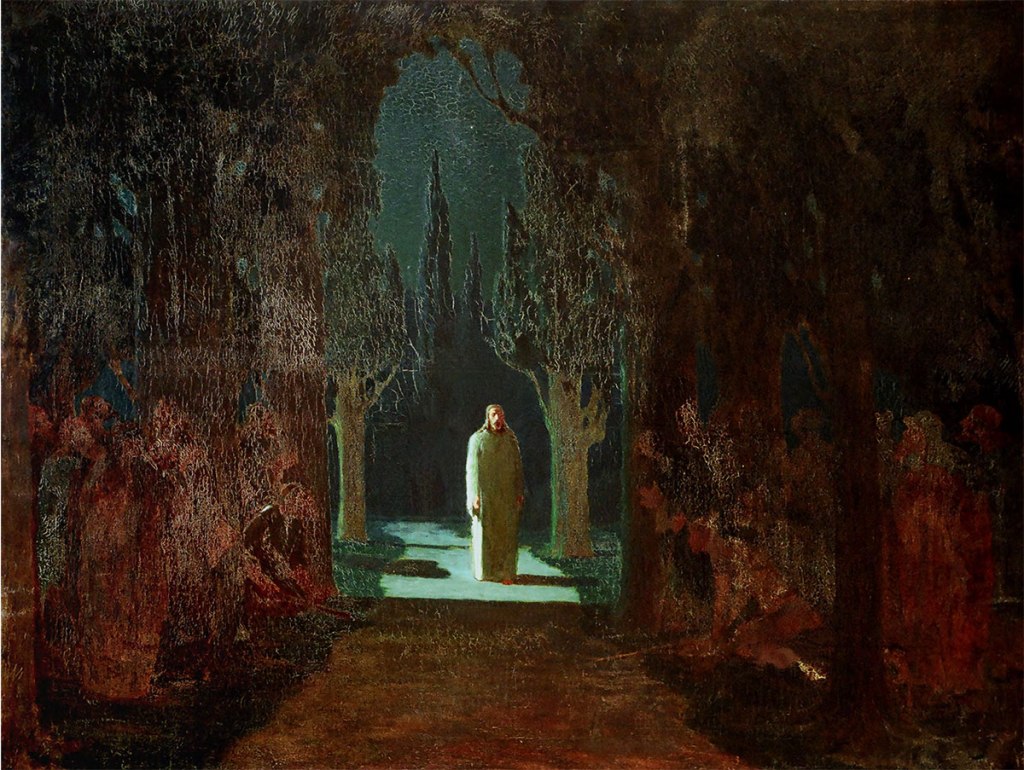
            As they enter Gethsemane their spirits are high and they are unified in their belief that Jesus may be right about a lot of things, but He is wrong about the disciples falling away and He is wrong about Peter denying Jesus.  Jesus has eight of the disciples sit and He takes Peter, James and John a little ways deeper into the olive grove.  Jesus is sorrowful and troubled and begins to talk like He has never talked before.  Matthew 26:38 (ESV) 38 … “My soul is very sorrowful, even to death; remain here, and watch with me.” 

            Jesus then goes a little farther and falls on His face and prays.  Matthew 26:39 (ESV) 39 …“My Father, if it be possible, let this cup pass from me; nevertheless, not as I will, but as you will.” 

            Jesus knows what is coming…the humiliation, the suffering, the torture, the dying an excruciating death.  But that is not the worst.  Jesus will be left utterly alone.  Already the crowds are gone, the group of followers is gone, one disciple will soon betray Him.  Of the brave disciples who all declared they would die rather than deny Jesus — eight are asleep near the entry to the olive grove, and the three He asked to watch with Him are also asleep.  Jesus goes to sleeping Peter and says, Matthew 26:40–41 (ESV) 40 … “So, could you not watch with me one hour? 41 Watch and pray that you may not enter into temptation. The spirit indeed is willing, but the flesh is weak.”  The disciples all intend to do well, but are unable.  In reality, there is nothing for them to do.  Jesus prays again, Matthew 26:42 (ESV) 42 … “My Father, if this cannot pass unless I drink it, your will be done.”  After praying a third time, Jesus wakes up the disciples and together they go to meet Judas who is coming with a crowd carrying swords and clubs.  Judas betrays Jesus and the crowd seizes Him.  Peter draws his sword to fight back striking one of the men, but Jesus tells him, Matthew 26:52–54 (ESV) 52 … “Put your sword back into its place. For all who take the sword will perish by the sword. 53 Do you think that I cannot appeal to my Father, and he will at once send me more than twelve legions of angels? 54 But how then should the Scriptures be fulfilled, that it must be so?”  

            After dinner, Jesus gave the cup of the new testament in His blood for the forgiveness of sins to the disciples and to you.  Now Jesus will drink the cup of God’s wrath, taking upon Himself the punishment for those sins.  He is the sinless Son of God who takes on Himself the sin of the world.  2 Corinthians 5:21 (ESV) 21 For our sake [God the Father] made him to be sin who knew no sin, so that in him we might become the righteousness of God.”

Jesus will do it alone.  He has to do it alone.  He is the only one that can pay this price.  In Jesus’ drinking of the cup of God’s wrath, He is forsaken by God the Father.  It is the Father’s wrath inflicted on Jesus to save sinners.  

Jesus bears the penalty for your sin.  Jesus suffers separation from the Father, in your place.  Forsaken by the Father, Jesus suffers the full wrath of God for the sin of humanity.  He alone is the substitute for humanity.  He endures the total separation from God the Father that humanity deserves in order to reconcile God and man.  Matthew 27:46 (ESV) 46 And about the ninth hour Jesus cried out with a loud voice, saying, “Eli, Eli, lema sabachthani?” that is, “My God, my God, why have you forsaken me?” 

            Jesus praying alone in Gethsemane is the beginning of His utter aloneness being arrested, being before Caiaphas and the Council, being denied by Peter, being beaten and mocked, questioned by Pilate, flogged, crucified, and laid in the tomb.  Jesus is truly all of Israel reduced to one perfect, final sacrifice.  He is abandoned by the crowds, by His followers, by His disciples and then, finally… by God the Father.  It is the Father’s will that Jesus suffer and die alone.

            LCMS President Matthew Harrison wrote this in the Lutheran Witness in June of 2020 in the throes of COVID regarding whether God wills suffering and affliction. 

            “The answer comes most clearly in Gethsemane. “Father, if you are willing, remove this cup from me. Nevertheless, not my will, but yours, be done” (Luke 22:42). There it is. God the Father wills the suffering of God the Son. Under the pressure of the sins of the world, Jesus seemed to waver. Yet He, “who in every respect has been tempted as we are, yet without sin” (Heb. 4:15), also did not sin at that tense moment. Jesus said, “No one takes [my life] from me, but I lay it down of my own accord” (John 10:18).

So there you have it. God the Father and God the Son willed that the Son should suffer and die. God willed death. God willed suffering. At first, this is disconcerting. Isn’t death a result of sin? Isn’t suffering a result of sin? So, is God the cause of sin? No. God is not the cause and source of sin and death. Yet God Himself makes use of the curse of sin — suffering and death — for His good purposes. In doing so, He most often works in a hidden way. Our life is “hidden with Christ in God” (Col. 3:3). Just think of it. As Christ was dying on the cross, His followers were terrified, distraught, hopeless, helpless. They thought that God had abandoned Jesus, and them. But it was not so. The Father had abandoned Jesus to death for them. The greatest act in the history of the universe appeared to be the most pathetic, powerless and useless failure.”[1]

            Jesus is sorrowful in Gethsemane because, as He prepares to drink the cup of God’s wrath to save you, He will be forsaken by everyone, including His Father.  This is the Father’s will.  Jesus alone is the Lamb of God who takes away the sin of the world.  Alone Jesus gives His life to save you.  Matthew 26:42 (ESV) 42 … “My Father, if this cannot pass unless I drink it, your will be done.”  Amen.  


[1]June 1, 2020 / Letter From the PresidentPrint FeatureThe Magazine / By Matthew Harrison / COVID-19Suffering

A Mighty Servant is Our God

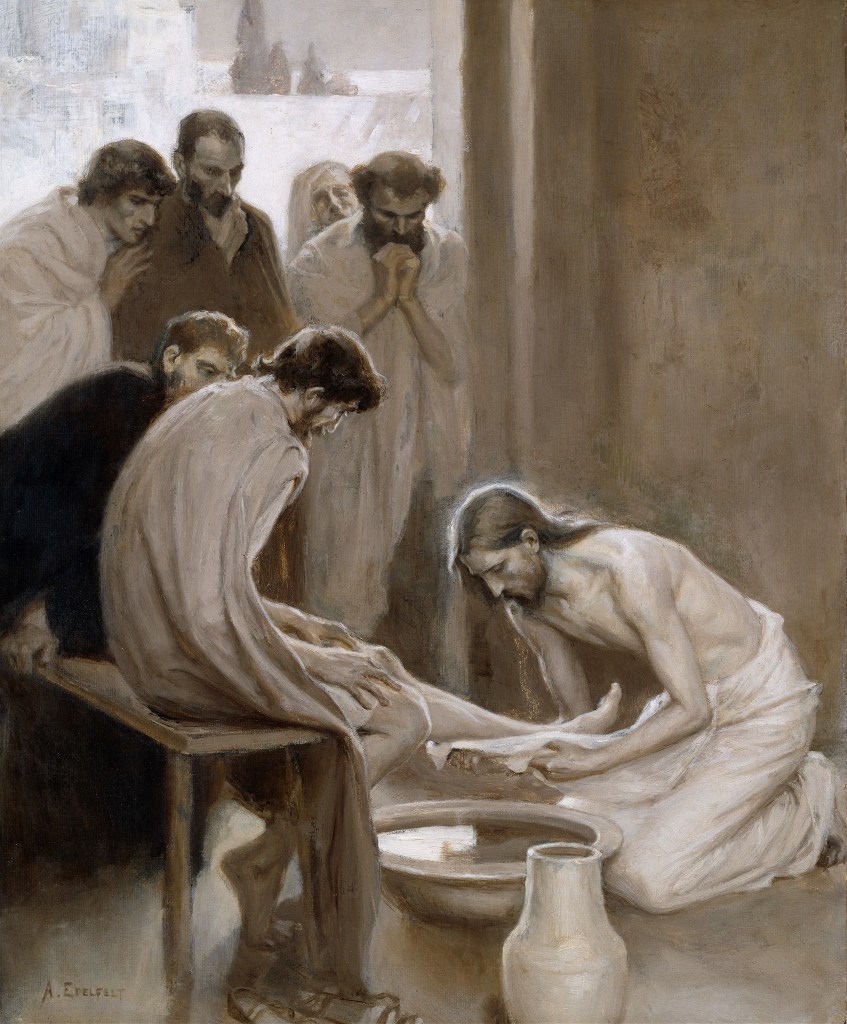
Painting by Finnish artist Albert Edelfelt (1854 – 1905) Jesus Washing the Feet of his Disciples (1898)

WORSHIP VIDEO LINK 

WORSHIP AUDIO LINK

SERMON AUDIO LINK

BULLETIN

SERMON TEXT BELOW

Daniel English
February 25, 2026
Sermon – Lent 1 – Midweek Wednesday
John 13:1-20;

A Mighty Servant Is Our God

In the Name of the Father, and of the Son, and of the Holy Spirit. Amen.

Lent is a time when the church conforms her habits to the suffering of Christ. Traditionally, Christians have fasted from various good things in order to devote themselves to Bible reading and prayer and almsgiving. During Lent we pay special attention to the sufferings of Christ. We remind ourselves just how serious our sin is, how it provokes the wrath of an Almighty God, and we remind ourselves that the wages of sin is both temporal and eternal death (Romans 6:23). +++ We remember that the punishment we deserve isn’t simply swept under the rug and forgotten… Instead, our punishment is carried out on one righteous and perfect Man, Jesus Christ. +++ Lent isn’t a time to drum up our emotions, to make our repentance a performance, to disfigure our faces in a great showing of our devotion, or even to relish all of the beautiful, minor key music. And it isn’t just in these 40 days alone that we repent of our sins. But as the Preacher says, “For everything there is a season…” (Ecclesiastes 3:1), and we use this season of weeping and mourning and fasting to remind ourselves just how much Christ has suffered for us. FOR US. FOR YOU.

This Lententide we will follow Jesus through the last 24 hours before His death, from the Upper Room to the cross. As the Lenten Hymn says, “Ye who think of sin but lightly / nor suppose the evil great / Here may view its nature rightly, / Here its guilt may estimate. / Mark the sacrifice appointed, / See who bears the awful load; / ‘Tis the Word, the Lord’s anointed, / Son of Man and Son of God” (“Stricken, Smitten, and Afflicted,” LSB 451:3). +++ When we remember Christ’s great suffering, we begin to understand the gravity of our sin. But we also begin to understand the depth of His love for us.

St. John makes this connection in our reading for today: “Now before the Feast of the Passover, when Jesus knew that his hour had come to depart out of this world to the Father, having loved his own who were in the world, he loved them to the end” (John 13:1). Jesus knows that His hour has come. Up to this point He has loved His own, and He will continue to love His own to the end. That end is to be betrayed, arrested, mocked, scoffed at, spit on, struck in the face, and whipped. And at the conclusion of a bogus trial, He will be put to death. Just 24 hours before all of this suffering, Jesus is in the Upper Room with His disciples and He decides to wash their feet.

What does it mean that Jesus is washing His disciples’ feet? It’s hard not to import some kind of modern meaning into an event like this. Maybe you think feet are gross and washing someone else’s feet even grosser. You might think footwashing is an awfully irregular, or important, or intimate thing for Jesus to be doing. The reality is, in Jesus’ time footwashing is nothing unusual. In the Old Testament, when Abraham welcomes the Lord and two angels as guests, he calls for water to be brought so that they may wash their feet (Genesis 18:4). Lot offers the same hospitality to those same guests in Sodom (Genesis 19:2). When Isaac and his traveling companions reach Laban’s house, there is water to wash their feet (Genesis 24:32). Joseph, when he welcomes his brothers back to Egypt, provides water so they can wash their feet (Genesis 43: 24). Footwashing was done regularly by priests during their priestly duties (Exodus 30:19), or by anyone when entering a house or before meals. For thousands of years, from Genesis to the time of Christ, footwashing has been a normal part of hospitality in a culture where one walks around in the dust wearing sandals all the time. Footwashing back then is like taking off your shoes at the front door today.

In our reading for today, the footwashing is not unusual. What is unusual is… WHO… is doing the washing. “Jesus, knowing that the Father had given all things into his hands, and that he had come from God and was going back to God, rose from the supper. He laid aside his outer garments, and taking a towel, tied it around his waist. Then he poured water into a basin and began to wash the disciples’ feet and to wipe them with the towel that was wrapped around him” (John 13:3-5). The footwashing is not what is striking. It is striking that the One through Whom and for Whom all things were created (Colossians 1:16) is acting as a servant.

With this in mind, Peter’s struggle is not so hard to understand. “[Jesus] came to Simon Peter, who said to him, ‘Lord, do you wash my feet?’ Jesus answered him, ‘What I am doing you do not understand now, but afterward you will understand.’ Peter said to him, ‘You shall never wash my feet’” (John 13:6-8a). If anyone has begun to understand who Jesus is, it is Peter. Peter said, “You are the Christ, the Son of the living God” (Matthew 16:13-20). And now Jesus — the Christ — the Son of the Living God — has come to Peter to wash his feet. Unsurprisingly, Peter responds passionately: “You shall never wash my feet.” The interchange is almost comical. Jesus wants to wash Peter’s feet, Peter basically says, “No way!” Then “Jesus answered him, ‘If I do not wash you, you have no share with me.’” So Peter says, “Lord, not my feet only but also my hands and my head!” (John 13:8b-9). Oh, Peter… we love Peter. Let’s learn from him. What mistakes does he make? +++ Luther, when he is discussing human nature around the dinner table is quoted as saying, “The world is like a drunken peasant. If you lift him into the saddle on one side, he will fall off the other side” (Luther’s Works American Edition, Vol 54, pg 111). Peter’s first mistake is pride… and the second is enthusiasm. In his pride, Peter rejects the Word of God altogether. In his enthusiasm, he thinks it’s okay to add to it.

Peter’s pride prevents him from receiving the Kingdom of God as a little child. Our pride makes it an offensive thing to receive Christ’s gifts. Christ wants to be the one to do the washing. Christ does the cleansing. Christ chooses to give the gift freely, and Peter falls off one side of the horse. PRIDE. +++ Jesus makes it clear: “If I do not wash you, you have no share with me” (John 13:8b). If Jesus does not do the work, you have no share with Him. We’re drawn to this same self-righteous pride. Instead of the righteousness of faith given as a gift, we want to play some part in our own salvation. We want to contribute something! It seems only polite, it looks like humility… but it’s pride. +++ What only appears to be humility makes the work of Christ meaningless, and seeks to replace it with works of our own. This pride is called works righteousness, and it is always a temptation. Avoid it! Paul teaches against this error in his letter to the Galatians: “Who has bewitched you? It was before your eyes that Jesus Christ was publicly portrayed as crucified. Let me ask you only this: Did you receive the Spirit by works of the law or by hearing with faith? Are you so foolish? Having begun by the Spirit, are you now being perfected by the flesh? […] You are severed from Christ, you who would be justified by the law; you have fallen away from grace” (Galatians 3:1b-3; 5:4). +++ You think your sanctification merits you something or that you’re not as deserving of hell as that person over there, or that it makes you better than this person over here. Repent… It’s pride.

Peter is quickly corrected. Jesus says, “If I do not wash you, you have no share with me” (John 13:8b). What happens next looks like piety: “Lord, not my feet only but also my hands and my head!” Peter adds to the Word and example of Christ, and he falls off the other side of the horse. ENTHUSIASM. How often are we tempted to leave the clear Word of Christ for something else? But we don’t need anything else. Not councils or popes, not inward affirmations or special revelation. The Word is sufficient. Christ is sufficient. When your emotions, your experiences, or your intellect push you to change or add to the Word of God, as if you have authority over it, repent… It’s enthusiasm.

Thankfully, Jesus is merciful to us, just as He is merciful to Peter. Christ is good to us. He forgives us and corrects us, and sets himself before us as a Holy Example. Jesus says, “For I have given you an example, that you also should do just as I have done to you” (John 13:15). +++ Jesus is given all power and authority by God the Father, and with it He becomes a Suffering Servant to those whom He loves. TO US. TO YOU. You are to do the same: any authority given to you should be used in service to others. Now your works, instead of a prideful distraction from the merit of Christ, become a blessing to your neighbor. You don’t act as though you’re owed anything, you know you’re not capable of earning God’s grace, but you serve one another in all humility. You remember that you have been forgiven much, so you are quick to forgive others. You walk in faith, knowing that Christ loves you and died for you, while you were still a sinner. By His death and resurrection, you are made righteous through faith before God. You are cleansed in Holy Baptism, washed clean. And He serves you His own Body and Blood in the Lord’s Supper, which strengthens and preserves you. In Lent, don’t take your sins lightly, but remember that Christ has taken your sins to the cross, and He removed them as far from you as the East is from the West.

Have you been washed? Christ’s Word says, “You are clean.” Don’t reject it. Don’t seek to take anything away from it or add anything to it. Just trust in it. It is enough.

In the Name of Jesus. Amen.

How to Handle Temptation

WORSHIP VIDEO LINK (linked after 10:45 AM Service)

WORSHIP AUDIO LINK

SERMON AUDIO LINK

BULLETIN

SERMON TEXT BELOW

Lent 1 2026
Immanuel Lutheran Church, Hamilton, Ohio
Pastor Kevin Jud
February 22, 2026
Genesis 3:1-21, Romans 5;12-19, Matthew 4:1-11

Sermons online: 
Text and Audio:         immanuelhamiltonchurch.com   click “sermons”
Text:                           pastorjud.org   
Audio:                         pastorjud.podbean.com 
itunes:                         bit.ly/pastorjud
Full Service Audio:    bit.ly/ImmanuelWorship

Before switching to mostly Aldi and self-checkout, I remember going to the grocery store and seeing the tabloid newspapers prominently displayed by the checkout.  As I waited in line I could read the headlines of the National Enquirer.  “Man abducted by UFO for the 4th Time”, “Elvis is alive,”  “Bigfoot shot by Montana Police.”

The headlines were entertaining but knowing the reputation of the National Enquirer I had doubt that they were true.  In order to trust the message, you need to trust the messenger. 

            Adam and Eve are in the Garden of Eden and there is no checkout line.  There is no National Enquirer.  Adam and Eve have only one messenger – God.  Can they trust this messenger?  They have been created in the image of God.  Their will and God’s will are one and the same, and all is good… until evil comes into the Garden. 

            A high angel is overcome with pride and arrogance and rebels against God, likely taking a third of the angels with him. We do not know much about Satan’s rebellion, but we soon find that ancient serpent slithering around in Paradise looking to deceive Adam and Eve.  

            The serpent deceives by planting seeds of doubt.  He asks Eve, Genesis 3:1 (ESV) 1 … “Did God actually say, ‘You shall not eat of any tree in the garden’?” The devil uses doubt and confusion and misdirection against Eve.  Eve responds, Genesis 3:2–3 (ESV) 2 …“We may eat of the fruit of the trees in the garden, 3 but Eve said, ‘You shall not eat of the fruit of the tree that is in the midst of the garden, neither shall you touch it, lest you die.’ ”  Eve seems to be holding her own against the serpent — she knows what God said.  But the lying devil continues to sow doubt and mixes it with an appeal to pride and the attraction of the forbidden fruit.  Genesis 3:4–5 (ESV) 4 But the serpent said to the woman, “You will not surely die. 5 For God knows that when you eat of it your eyes will be opened, and you will be like God, knowing good and evil.” 

            The devil entices Eve.  Sowing doubt softened her up so the appeal to pride works well.  “You will be like God.”  And so, even though they have abundant fruit from all the other trees in the Garden, the forbidden fruit of this tree is just so appealing.  Genesis 3:6 (ESV) 6 So when the woman saw that the tree was good for food, and that it was a delight to the eyes, and that the tree was to be desired to make one wise, she took of its fruit and ate, and she also gave some to her husband who was with her, and he ate.” 

            Adam and Eve had one command and the devil is quickly able to get them to rebel.  He appeals to pride and secret knowledge and they give in to the serpent’s deceptions and the world is changed forever.  Paradise is no longer — and the first man and woman feel shame at their nakedness. In their fall all of their offspring are brought down into sin.  The beautiful harmony between God and man walking together in unity of purpose and desire is shattered, and Adam and Eve desperately try to cover their nakedness and hide from God. The devil said, “You will not surely die,” but he was lying.  Death came into the world and we still live under the shadow of death today.

            You like to think that if it were you, you would have done better.  You want to tell yourself, “I could have resisted the devil.  I would have carefully listened to God and done what He said.”  You want to think that, and yet the devil successfully uses the same strategies against you to this day.  The devil sows doubt in your mind about what God has clearly said.  The devil appeals to your pride.  The devil uses your appetites against you to get you to partake of forbidden fruit.  The devil lies to you about finding true freedom in indulging your lusts and desires. The deceiver is quite adept at using lies and doubt and pride to get you to ignore God’s commands and follow your own ideas. 

Much of our media and education system seem to be geared toward trying to convince you that you are way too smart to believe that God created the world. Smart people believe life is the result of an endless series of random mutations.  They try to convince you that only a fool would believe that God sent His Son in the flesh to be the sacrifice for sin and that He gives out forgiveness in baptism, in His Word, and in His Body and Blood.  They tell you that you are way too smart to believe God. Instead, you should just trust your own feelings.  You can be like God.  The devil prowls like a roaring lion looking for someone to devour.  What can you do?  How can you fight the devil?  

            In our Gospel reading today we hear about the devil tempting Jesus in the wilderness.  The devil tempts Jesus with doubt and appetite and pride.  Jesus has been fasting for 40 days and He is hungry when He encounters the tempter.  The devil goes right for a double temptation of doubt and appetite.  Matthew 4:3 (ESV) … “If you are the Son of God, command these stones to become loaves of bread.”  “If you are…”  Just forty days earlier down in the valley at the Jordan River Jesus was baptized and the heavens opened and God the Father declared, Matthew 3:17 (ESV) 17 …“This is my beloved Son, with whom I am well pleased.”  Now the devil tries to use this against Jesus. You think you are the Son of God…prove it to me.  And I know you are hungry…why don’t you just use your power to make some bread?  Fresh bread would taste so good.  Matthew 4:4 (ESV) 4 But [Jesus] answered, “It is written, “ ‘Man shall not live by bread alone, but by every word that comes from the mouth of God.’ ”  Jesus deflects the devil’s temptation.  But the evil one tries again.

            Matthew 4:5–6 (ESV) 5 Then the devil took him to the holy city and set him on the pinnacle of the temple 6 and said to him, “If you are the Son of God, throw yourself down, for it is written, “ ‘He will command his angels concerning you,’ and “ ‘On their hands they will bear you up, lest you strike your foot against a stone.’ ” 

            The devil tries doubt and pride.  Prove you are the Son of God by showing off your powers. Matthew 4:7 (ESV) 7 Jesus said to him, “Again it is written, ‘You shall not put the Lord your God to the test.’ ” 

            From the top of a high mountain where they could see all the kingdoms of the world, the devil tempts Jesus again with a shortcut to power and glory without having to go to the cross.  Matthew 4:9 (ESV) 9 And he said to him, “All these I will give you, if you will fall down and worship me.” Just give up on God the Father and do what I say and worship me.  Jesus answers, Matthew 4:10 (ESV) 10 … “Be gone, Satan! For it is written, “ ‘You shall worship the Lord your God and him only shall you serve.’ ” 

            Jesus is faithful where Adam and Eve fail.  Jesus is faithful where the people of Israel fail. Jesus is faithful where you fail.  Jesus is the Son of God.  He is Israel reduced to one.  He is the faithful one who fulfills the law. 

            There is a temptation in reading this account of Jesus and the devil in the wilderness that you read it as a do-it-yourself lesson for how to battle the Prince of Darkness, but it is not that.  The lesson to be learned here is that Jesus is faithful.  It is not that you are to be like Jesus, but that you belong to Jesus.  You are with Jesus to delight in His will and walk in His ways. 

            In baptism and confirmation you renounce the devil and all his works and all his ways.  You absolutely should resist the devil, but you should not do battle against the devil.  Jesus has done battle with the devil and Jesus won.  Jesus gives His victory to you.  His victory is your victory.  You have already defeated the devil because you are in Christ. 

            So what can you learn from Jesus’ encounter with Satan in the wilderness, and at Gethsemane, and on the cross.  Certainly you face ongoing temptations.  The devil, the world and your own sinful nature will try to get you to listen to them rather than to listen to God.  There are so many voices trying to get you to doubt God’s word.  They appeal to your appetites and pride to get you to listen to them and reject God.

            So when the temptation comes to stop caring and pull back and play it safe – you tell that temptation, “No thanks.  I’m with Jesus.”  When the temptation comes to run after something you should not have, or someone, or some feeling – you tell that temptation.  “No thanks, I’m with Jesus.”  When you get discouraged and start to believe that it is just not worth it to do the right thing, watch again the faithfulness of Jesus and declare, “It is worth it, because I am with the faithful one.  I am with Jesus.”[1]

            Listening to the devil or the world or your own sinful desires is like believing headlines of the National Enquirer.  Tell them, “No thanks. I’m with Jesus.”  Live not by lies.  Live by the Word of God.  You are with Jesus.  Amen. 


[1] Thanks to Dr. Jeffrey Gibbs, Concordia Theology, Lectionary at Lunch

Glorious Now, But Not Yet

WORSHIP VIDEO LINK (linked after 10:45 AM Service)

WORSHIP AUDIO LINK

SERMON AUDIO LINK

BULLETIN

SERMON TEXT BELOW

Daniel English
February 15, 2026
Sermon – Transfiguration
Exodus 24:8-18; 2 Peter 1:16-21; Luke 9:28-36;

Glorious Now, But Not Yet

In the Name of the Father, and of the Son, and of the Holy Spirit. Amen.

          “If you could invite any three people, living or dead, to a dinner party, who would you pick?” This sort of personal hypothetical has been popular since parlor games in the Victorian Era, maybe before. In the 60’s television hosts David Frost and Barbara Walters brought it from print media into television. Your answer can show-off a little bit of your history prowess. Politicians and other prominent members of society reveal who their influences are, who they respect, or what people they find to be most important or interesting. Former President Barack Obama was asked this question during his book tour, and he said: Abraham Lincoln, Martin Luther King Jr., and Nelson Mandela. The tech billionaire Elon Musk, when asked in a recent interview answered: William Shakespeare, Benjamin Franklin, and Nikola Tesla. You can only imagine what kind of conversation these groups of three people from different times would say to one another after being ripped out of their historical context and placed at a dinner party with you.

Our Holy Gospel reading for today puts us in a situation similar to these hypothetical dinners. How about Moses, Elijah, and Jesus Christ? Today we hear about the Transfiguration of Our Lord, and it is one of the great mysterious events of the Bible. Jesus takes His inner circle: Peter, James, and John, up to a mountain top and is transfigured before their eyes. Matthew records that Jesus’ face “shone like the sun” (Matthew 17:2). His clothes become dazzling white. And then another detail included in all three gospel accounts of the Transfiguration: Jesus is joined on top of the mount by Moses and Elijah.

          Approximately 1,500 years before th birth of Christ, Moses led God’s people out of slavery in Egypt, he received the Law on top of Mount Sinai, and by the power of the Holy Spirit he wrote down the first 5 books of the Bible, known as “Torah” or “The Law.” When Moses died —just outside of the Promised Land— he was laid to rest by God Himself. Nobody but God knows where the body of Moses was buried.

          Elijah, about 850 years before the birth of Christ, was fed by ravens in the wilderness (Elijah didn’t eat the ravens… but they were sent by God like an ancient meal delivery service to bring him bread and meat every morning and every evening). Elijah raised a widow’s son from the dead in Zarephath. Elijah confronted Ahab, the wicked King of Israel, and stood alone against 450 priests of Baal in a showdown that resulted in their slaughter. Elijah was one of the few men who never had to face death, his body was never found because God took him directly into heaven by a whirlwind.

Moses and Elijah are two of the most notable and powerful prophets of the Old Testament. Both of these men were extremely important to the bible-believing community, and at different times in history, both of these men heard God’s Word spoken to them directly on top of a mountain. Now they are on top of the Mount of Transfiguration having a conversation with Jesus. What are they talking about? Well we can do a whole lot more than just imagine it, thanks to Luke’s account! Luke tells us something neither Matthew nor Mark record:

“And behold, two men were talking with him, Moses and Elijah, who appeared in glory and spoke of his departure, which he was about to accomplish at Jerusalem” (Luke 9:30-31). Jesus, Moses, and Elijah are speaking about Christ’s departure. What departure? The Greek can help us here because you know the word: ἔξοδος. The Greek word for “departure” is exodus. There isn’t a biblically literate, Greek-reading person in the Levant who could hear the word exodus without thinking about Moses leading the 12-mile train of Hebrews out of Egypt and slavery toward the Promised Land. Hopefully you think of that too, but this is Jesus’ exodus we’re talking about, not Moses’. The liberating work of God through Moses and the plagues which culminated in the Passover that spared God’s people from death and released them from the yoke of Egyptian slavery is nothing to us until it finds its fulfillment in the redemptive work of Jesus Christ on the Cross. The ancient exodus from Egypt that Moses records in the Scriptures foreshadows our exodus —our departure— from sin death and the devil. Just as God with His mighty Right Hand delivers the Hebrews from their Egyptian taskmasters, so also God with His mighty Right Hand Man, Jesus Christ, delivers us from our cruel taskmaster, the devil, unto life everlasting. Moses is here representing the Law, and Elijah the prophets. Together they are witnesses to the fact that all the Law and all the Prophets are fulfilled in the Person and Work of Jesus Christ. So Jesus, Moses, and Elijah are our special dinner guests, and they are in conversation about the mighty work of salvation that Jesus is about to accomplish. And He did accomplish it for us.

But for Peter, James, and John on the Mount of Transfiguration, these things have yet to be accomplished. Peter, James, and John see this amazing glimpse of the Glory of Our Lord, and they love it. Peter recognizes the men with Jesus and says, “Master, it is good that we are here” (Luke 9:33). He wants to make tents for all three and stay for a while. Peter is misguided. He says it is good to be here on this Mount of Transfiguration, but Jesus will show Him that what He is about to do is better and necessary. Peter doesn’t yet understand the theology of the cross. And so, the cloud descends, the Father declares from heaven, “This is my Son, my Chosen One; listen to him” (Luke 9:35)! Then the dazzling light of the Transfiguration fades, and Our Lord, glorious now, but also not yet, begins on the road to the cross because “suffering comes before glory” (Just Concordia Commentary p###). After Jesus descends the Mount of Transfiguration, He will “set his face to go to Jerusalem” (Luke 9:51). Jesus has begun to tell His disciples that He will go to Jerusalem where He “is about to be delivered into the hands of men” (Luke 9:44)… where He “must suffer many things and be rejected by the elders and chief priests and scribes, and be killed, and on the third day be raised” (Luke 9:22). The Transfiguration is a point of transition between Christ’s ministry in Galilee and His journey to Jerusalem… His journey to the cross.

This is confusing to the disciples, even those in Jesus’ inner circle. Here on top of the mountain, Jesus is resplendent and glorious, and it’s heaven on earth. The disciples don’t understand that Jesus still has to suffer and die. We shouldn’t be too hard on Peter! If it weren’t for God’s revealed Word telling us that Peter didn’t know what he was saying, we would all nod in agreement. “Yes, it is good, Lord, to be here!” You might be tempted to review the list of Peter’s errors and scoff at him: “Foolhardy Peter, doubting the Lord’s instructions with the fishing net (Luke 5:5), taking his eyes of Jesus and sinking into the Sea of Galilee (Matthew 14:30), rebuking the Lord on the way to Jerusalem (Matthew 16:22), refusing to have his feet washed in the upper room (John 13:8)… even denying the Lord on the night of His crucifixion (Luke 22:54-62)…” It seems Peter is somewhat slow to understand.

But how do you respond when Jesus calls you away from present glory to suffering like His? Do you understand the theology of the cross? Christ says, “If anyone would come after me, let him deny himself and take up his cross daily and follow me” (Luke 9:23). Do you take up your cross daily, or do you despise it and chafe at the Lord’s authority? Christ says, “For whoever would save his life will lose it, but whoever loses his life for my sake will save it” (Luke 9:24). Do you willingly lose your life in Christ, or do you cling to your life and build it on your possessions or your career, or your family… almost anything else? Jesus’ movement from His Transfiguration, bright and glorious, to the dark and bloody cross is a holy example for you as you walk in the way from your baptism, the washing of regeneration, to your death. Through the water and the Word of your baptism you receive faith, the Holy Spirit, the forgiveness of sins, and all the wonderful gifts that Christ promises to His Church. You are joined to Christ and your sinful self is put to death… drowned, and you rise up to walk in the newness of life. But then… you go on to suffer.

Today little Euphemia [will be baptized / was baptized] and she [will be / is] clothed with the dazzling righteousness of Christ… today, it is good Lord, to be here! Euphemia [will be / is ] made glorious today… you all are made glorious in your baptism… but also… not yet. First, Euphemia, and all of us, will suffer. She will face temptation, heartbreak, grief, and sorrow. She will suffer under my flaws as a father, and she will battle against the devil, the sinful world, and her own sinful flesh. This is what Christ has called each and every single one of us to. It seems daunting, maybe you’re overwhelmed, but my brothers and sisters in Christ, take heart: Jesus Christ has overcome the devil, the sinful world, and your sinful flesh. Chrit does the battling for you, and He has won the victory. His suffering once for all earns mercies that are given to you anew every single morning. Because of Christ’s departure, we can depart this service and this life in peace. God’s Word has been fulfilled.

Today we say goodbye to our “Alleluias” until Easter. We change our paraments to purple, and then to black. Some of you fast also from meat or facebook or some other good gifts throughout Lent. We suffer a little bit to train ourselves when deeper suffering comes. But you must remember that your suffering is only for a time, and “the sufferings of this present time are not worth comparing with the glory that is to be revealed to us” (Romans 8:18). In our baptism we are glorious with Christ now, but also not yet. For now we walk in danger and trials all the way, until that final day when He comes again in glory to judge the living and the dead, to make all things new, and to bring us into his heavenly kingdom where we will stand in the Glorious Light of Christ forever.

In the Name of Jesus. Amen.

The World is a Better Place Because of You

WORSHIP VIDEO LINK (linked after 10:45 AM Service)

WORSHIP AUDIO LINK

SERMON AUDIO LINK

BULLETIN

SERMON TEXT BELOW

Epiphany 5 2026
Immanuel Lutheran Church, Hamilton, Ohio
Pastor Kevin Jud
February 8, 2026
Isaiah 58:3-9a, 1 Corinthians 2:1-16, Matthew 5:13-20

Sermons online: 
Text and Audio:         immanuelhamiltonchurch.com   click “sermons”
Text:                           pastorjud.org   
Audio:                         pastorjud.podbean.com  i
itunes:                         bit.ly/pastorjud
Full Service Audio:    bit.ly/ImmanuelWorship

            If you are going to grill some steaks, how long can you let them sit outside on a table before getting them on the grill?  Ten minutes?  30 minutes? An hour?  Two hours?  What would happen if one of those steaks gets pushed off the table onto the ground and is forgotten for a couple of days?  There are bacteria like salmonella and e coli and listeria already on the meat and if left unrefrigerated, the bacteria start to grow and in a couple of hours the meat is dangerous to eat.  It will loses its color and starts to smell which attracts flies that lay eggs and soon maggots are hatching.  The steak is now disgusting and rotten and ruined.

            Before the advent of refrigeration, one way of preserving meat was with salt.  Salt pulls moisture out of the meat and out of the bacteria, and the bacteria are unable to grow and the meat is preserved against rot.

            This world in which you live is, in so many ways, rotten. Evil is already everywhere looking for the right conditions to grow.  The world is filled with those who promote anger and hatred and violence and abuse and greed and neglect and hedonistic selfishness.  People take God’s good gifts and twist them into evil.

Like beef sitting at room temperature, the devil just needs the right conditions for evil to start to grow.  It can start small with a little conflict, a little anger, a little insult, a little greed, a little lust.  Evil begins to grow, and once it takes hold, the scent attracts more evil that moves in to destroy, spiritually, mentally and physically. Left at room temperature the once good piece of meat becomes garbage.  Left to let evil grow, a once good person is ruined. 

There is an antidote to the rot of sin; it is the salt of God.  The salt of God brings His love and forgiveness and dries up evil so the devil cannot get a foothold.  This salt is so powerful that it does not only preserve against rot, but also reverse the effects, it heals and restores wholeness.

            Where can you get this salt of God?  Where can you get this powerful weapon against evil?  Look in the mirror.  Jesus says to the disciples — and to you… Matthew 5:13 (ESV) 13 “You are the salt of the earth…” You bring the love and forgiveness of God to those around you.  Being the salt of the earth, your presence prevents rot.  You bring healing and restoration to hurting people.  You stop evil from advancing with the power of God’s love and forgiveness flowing through you.  And not only are you the salt of the earth… Matthew 5:14 (ESV) 14 “You are the light of the world…”  As a redeemed follower of Jesus, you fight rot and darkness.  

            In the Sermon on the Mount Jesus explains your status before God.  You are poor in spirit.  You have nothing to offer God in exchange for eternal life.  You are spiritually bankrupt… and God blesses you beyond comprehension.  You are in the Kingdom of heaven right now — and for eternity. 

You are in the Kingdom of heaven but, for now, you still live in this world.  You see the rot and the darkness in the world and in yourself — and you grieve over it – and you are blessed — you will be comforted.  You know you are powerless; you know you are meek… and you are incredibly blessed by God. You will inherit the earth. 

            Jesus declares.  You are the salt of the earth.  You are the light of the world.  If Jesus declares it, you should believe it.  You are the antidote to rottenness in the world. You are the cure for darkness in the world.  Your presence as a redeemed child of God makes the world a better place.  Matthew 5:16 (ESV) 16 …let your light shine before others, so that they may see your good works and give glory to your Father who is in heaven.”

            Let you light shine by doing good deeds for others. Your good deeds may, at times, be big, audacious works to help others, but, more likely, your good works are your simple, daily, interactions with those around you.  Your good deeds are you being salt and light to your parents, your children, your spouse, your coworkers, your classmates, the folks at the store, your neighbors, those you interact with on social media, and anyone else you come into contact with.  You are salt and light to others in your life and you make the world a better place. You are salt and light in caring for others.  You are salt and light as you live your ordinary life in an extraordinary way because Jesus has redeemed you and made you holy.

            The Sermon on the Mount is radically counter cultural. Jesus cranks up the commandments so there is no doubt that all have sinned and fall short of the glory of God. He calls for His followers, the salt and light of the world, to live profoundly different lives from what the devil, the world and your own sinful nature promote. 

            If someone strikes you on the right cheek, turn the other also.  If they sue you for your tunic, give them your cloak as well.  If they force you to go one mile, go with them two.  Matthew 5:44 (ESV) 44 … Love your enemies and pray for those who persecute you…” 

            When someone does you wrong you have the right to retaliate, but as salt and light you do not retaliate because Jesus did not exercise His right to get even with you.  Instead of Jesus punishing you for your sin, He takes your sin to the cross, and gives you His perfection. 

You are salt and light to the world by showing mercy to others like Jesus shows mercy to you.  As salt and light you are a sponge for evil, you absorb the evil so it cannot grow.  In this way, wherever you are, there is less evil and the world is less rotten and dark.  Because of your presence, the world is a better place.

As salt and light you are pure in spirit – you are faithful to the true God; Father, Son and Holy Spirit – faithful to the Word of God.  You reject false gods and false teachers, and you gently and patiently speak the truth in love about forgiveness coming only from Jesus on the cross.  You call all to repent and follow Jesus.  And the world is a better place. 

Being salt and light you are a peacemaker.  Salt and light brings the news that God and man are reconciled in Christ. Salt and light brings Good News to a world that does not know that it can be at peace with God.  You have the peace that is beyond understanding and you bring this peace to people in a rotten, dark world — and the world is a better place. 

            As salt and light you do good works and people see God’s goodness in what you do.  With this last big snowstorm many of you shoveled out your driveway, and then your elderly neighbor’s.  You check on the vulnerable to make sure they are okay.  You prepare meals for busy new parents.  You give generously to support our Christian Service fund to help those in need of utility and rent payments to keep warm and safe.  You are salt and light in so many different ways as you bring God’s forgiveness and love to the world.  You are the salt of the earth.  You are the light of the world. 

            The frustrating thing is that you are salt and light living in a dark, rotten world, and you have a problem.  You are a natural sinner and sin comes naturally.  You are salt and light, but sometimes you act like you are not.  You claim the name of Christian, but you act like rot and darkness.  And God’s law convicts you and you grieve your sin.

When it happens.  When you act like saltless salt — when you behave like a lamp covered by a basket – when you give in to your sinful desires, when are tempted to believe the devil who tells you that you are good enough, or you let the devil’s accusations take hold and you start to despair.  When you find yourself not living as salt and light — and you will — over and over and over again… you learn — again — that you are, indeed — poor in spirit.  You are an honest to goodness sinner.  You really are in bondage to sin and cannot free yourself.  You really are a sinner who needs Jesus…and Jesus blesses you with His righteousness, innocence and blessedness. Jesus cleanses you and declares you holy.  Jesus rescues you and restores you to being salt and light. 

            The world is rotten.  You are the salt of the earth. The world is dark.  You are the light of the world.  You make the world a better place.  Amen. 

Strengths and Weaknesses

WORSHIP VIDEO LINK (linked after 10:45 AM Service)

WORSHIP AUDIO LINK

SERMON AUDIO LINK

BULLETIN

SERMON TEXT BELOW

Epiphany 4 2026
Immanuel Lutheran Church, Hamilton, Ohio
Pastor Kevin Jud
February 1, 2026
Micah 6:1-8, 1 Corinthians 1:18:31, Matthew 5:1-12

Sermons online: 
Text and Audio:         immanuelhamiltonchurch.com   click “sermons”
Text:                           pastorjud.org   
Audio:                         pastorjud.podbean.com 
itunes:                         bit.ly/pastorjud
Full Service Audio:    bit.ly/ImmanuelWorship

            Going to a job interview is stressful.  They are going to ask you a lot of questions about your strengths and weaknesses and you want to answer honestly… but maybe not too honestly. When they ask about your weaknesses what do you say?  I remember answering this question once, “I have trouble understanding why others don’t work as hard as I do.”  Google advises… “choose a real but minor weakness, frame it positively by showing you’re actively improving…making sure it’s not a core skill for the job.”

            Imagine for a moment you are at an interview for some kind of a reality show or something, but you are not sure exactly what. The interviewer asks you about your strengths and weaknesses.  What do you answer for your strengths?  I am smart. I am funny.  I am organized.  I can solve problems.  I am artistic.  I work hard. I am a good leader.  I am a good communicator.  I am good with money.  I am well liked.  What do you perhaps not say, but you hope they notice?  I have a firm handshake.  I am well dressed in expensive clothes and shoes.

            How would you answer the question about your weaknesses?  Maybe…I have difficulty delegating, or I have trouble saying, “No”? 

            Then you find out that the interview is with God for the reality of being adopted as His child.  How do you answer God about your strengths and weaknesses?  With God, your strengths can become vulnerabilities.  The things that you think impress the world like money and power and fame and beauty and hard work and wisdom — do not impress God.  These strengths can be vulnerabilities because it is so tempting to rely on them for your value.  It is so tempting to fear, love and trust in your strengths rather than God.  And so strengths become vulnerabilities.

            For all of us there is the danger of trusting money.  Godly stewardship of money is needed to not fall into the trap of loving money.  We live in a land of great abundance in which our basic needs are well taken care of.  By world standards we all have abundance. Do you see what you have and say, “Look what I have accomplished?”  Better to look at what you have, and say, “God has given me great responsibility to manage what He has put in my care.”  As a faithful steward of God’s creation you give regular, sacrificial, first-fruits offerings to acknowledge that all you have belongs to God and to prevent greed from getting a foothold.

            Love of money is a spiritual danger that can be managed through faithful, generous stewardship.  There is a more insidious strength that can become a vulnerability; wisdom.  Being intelligent and well educated is viewed very favorably.  It seems we are all very impressed by experts with lots of letters after their name.  We listen when, “Experts say…”  And there is nothing wrong with being smart and educated but there is a danger that you will fall for the devil’s enticement to believe that you are smarter than God.  It worked with Eve and it can work with you.

            When Paul is writing his first letter to the church in Corinth the Romans and Greeks had many deep thinkers and philosophers pontificating about the meaning of life.  There were the Stoics that taught that virtue was the highest good and that living according to reason and nature brings happiness.  There were the Epicureans who sought contentment and absence of pain. They believed the soul is material and mortal; just atoms that will disperse upon death.  There were also the Sophists who were traveling philosophers who taught rhetoric and philosophy focusing on wit, eloquence and persuasion. They believed truth and morality were relative and not absolute.  Jesus’ sacrifice on the cross does not make sense to these wise men of Corinth.  Paul calls them out for rejecting the wisdom of God. 1 Corinthians 1:20–21 (ESV) 20 Where is the one who is wise? Where is the scribe? Where is the debater of this age? Has not God made foolish the wisdom of the world? 21 For since, in the wisdom of God, the world did not know God through wisdom, it pleased God through the folly of what we preach to save those who believe.”

            The philosophies of our time are not so different and there is still the danger of rejecting anything about God that does not make sense to you. There is the lure to use your wisdom to explain away your sin rather than to repent.  There is the pull to rewrite God’s Word so it is in line with your thinking.  It is very popular in our age to believe you are smarter than God and elevate your intellect over Scripture. 

When I got out of college I was pretty sure I knew what the Bible taught about different things because I was convinced that the Bible pretty much taught what I believe.  Then I actually read the Bible and I had a startling discovery; there were teachings in the Bible that went against my personal beliefs.  What should I do?  I had to decide.  Who is right? Me?  Or God?

            This is an ongoing temptation.  I want to make God make sense to me.  I had a bit of a crisis on my vicarage because I realized that I did not understand Holy Communion.  How can the bread be the Body of Christ?  How can the wine be the Blood of Christ?  It does not make sense.  Then I came to an epiphany.  God does not have to make sense to me.  It is true because Jesus said it is true.  “Matthew 26:26–28 (ESV) 26 …“Take, eat; this is my body.” 27 …“Drink of it, all of you, 28 for this is my blood of the covenant, which is poured out for many for the forgiveness of sins.”  God does not need to make sense to me.  It makes sense that God does not make sense because He is the creator and I am the creation.

            The Lord declares in…Isaiah 55:8–9 (ESV) 8 For my thoughts are not your thoughts, neither are your ways my ways, [declares the Lord]. 9 For as the heavens are higher than the earth, so are my ways higher than your ways and my thoughts than your thoughts.” 

In this world our default idea about receiving eternal life is too often the same as the rich young man in… Matthew 19:16 (ESV) 16 …“Teacher, what good deed must I do to have eternal life?”  It is the wrong question.  Jesus forgives — not because of anything in you — but because of Christ crucified for you.  1 Corinthians 1:22–25 (ESV) 22 For Jews demand signs and Greeks seek wisdom, 23 but we preach Christ crucified, a stumbling block to Jews and folly to Gentiles, 24 but to those who are called, both Jews and Greeks, Christ the power of God and the wisdom of God. 25 For the foolishness of God is wiser than men, and the weakness of God is stronger than men.”  God does not have to make sense. 

            Religious movements of many sorts reject the sufficiency of Jesus on the cross for forgiveness because they believe they need to do something to be a part of their own salvation.  Church bodies reject infant baptism because it does not make sense to them that an infant can have faith.  Churches reject the real presence of the Body and Blood of Jesus in, with and under the bread and the wine of Holy Communion for the forgiveness of sins because it does not make sense that Jesus is at the right hand of the Father and on the altar at the same time.

            We are tempted by the devil to use wisdom and cleverness and eloquent language to change the Word of God to fit our own desires and the understandings of the world.  When the E.L.C.A. rejected that Jesus is the only way to salvation they claimed their new policy’s text “undergirds a posture of curiosity and humility” as the ELCA seeks to “learn from and engage” their inter-religious neighbors.”  One delegate argued that Jesus said, John 14:6 (ESV) 6 …“I am the way, and the truth, and the life. No one comes to the Father except through me.”  To which a pastor responded, “Our God is big enough for our family to include all of these interfaith siblings. Our God is big enough to admit that we do not know everything there is to know.”  The policy to reject Jesus as the only way to salvation was passed by a vote of over 97%.

Using the wisdom of the world, denominations have proudly endorsed clearly condemned sin because they reason that, “life is complicated,” and because of complications, sin must be okay.  Abortion on demand is celebrated.  Homosexuality and transgenderism is encouraged.  They use pretty words like, “we need to engage in “serious moral deliberation,” or, “this doesn’t violate Jesus’ principal of unconditional love and forgiveness.”  Or because, Genesis 1:27 (ESV) 27 …God created man in his own image…”.  Using half a verse and some nice words they reject all scripture that does not fit their ideas.  Indeed, God did create man in His own image in Genesis 1, and then Man fell into sin in Genesis 3.  To rationalize sin by saying God made me in His image could be used for any sin.  “I like to steal.  God made me this way.  Even though the 7th Commandment say, “You shall not steal,” it is okay.  God made me in His image.”  Those using this verse to support transgenderism generally don’t use the whole verse.  Genesis 1:27 (ESV) 27 So God created man in his own image, in the image of God he created him; male and female he created them.” 

We too can fall under the temptation to use our wisdom to try to redefine and justify our sin.  My refusal to forgive is just righteous anger.  We are going to get married, so living together now is just fine.  My hatred of others is because of my loyalty to God.  My private lusts don’t hurt anyone.  My anger is just who I am.  My sin is okay — because I say it is okay. 

            Back to your interview with God.  You are asked to list your strengths and weaknesses.  What do you say?  It really is not hard to answer.  You already did – just 0this morning on your knees as we began the Divine Service.  You confessed that you deserve punishment now and forever and you do not deserve to be forgiven.  You confessed you need Jesus to be your Savior. You declared before God that you have no strengths, you cannot rely on yourself, you are weak, lowly, poor in spirit, hungering and thirsting for things to be right.  You are spiritually bankrupt – and you are blessed by God now and for eternity.  You are saved by the power and wisdom of God through Christ on the cross for you.  In the waters of baptism, God washed you clean and adopted you as His beloved child — not because of your strengths — but because of His.

            1 Corinthians 1:28–29 (ESV) 28 God chose what is low and despised in the world, even things that are not, to bring to nothing things that are, 29 so that no human being might boast in the presence of God. 

            This flies in the face of the world’s understanding that you must rely on your own strengths.  You want to think you can count on yourself, but you cannot.  You rely on the Father’s gift of forgiveness in the blood of Jesus. 1 Corinthians 1:30–31 (ESV) 30 And because of him you are in Christ Jesus, who became to us wisdom from God, righteousness and sanctification and redemption, 31 so that, as it is written, “Let the one who boasts, boast in the Lord.” 

            What are your strengths and weaknesses?  Your strength is the word of the cross which is the power of God that overcomes your weakness.  That is why we preach Christ crucified.  Amen.