WORSHIP VIDEO LINK (linked after 10:45 AM Service)
WORSHIP AUDIO LINK
SERMON AUDIO LINK
BULLETIN
SERMON TEXT BELOW
Immanuel Lutheran Church, Hamilton, Ohio
Vicar Daniel English
January 4, 2026
Sermon – Epiphany of Our Lord
Isaiah 60:1–6; Ephesians 3:1–12; Matthew 2:1–12; Psalm 72:1–15;
Sermons online:
Text and Audio: immanuelhamiltonchurch.com click “sermons”
Text: pastorjud.org
Audio: pastorjud.podbean.com
itunes: bit.ly/pastorjud
Full Service Audio: bit.ly/ImmanuelWorship
Do Not Walk in Darkness
In the Name of the Father, and of the Son, and of the Holy Spirit. Amen.
“The light shines in the darkness, and the darkness has not overcome it” (John 1:5). In the early chapters of John’s Gospel, Jesus is described as the light of men (John 1:4), the light that shines in the darkness (John 1:5), the true light which gives light to everyone (John 1:9). Jesus says, “I am the light of the world. Whoever follows me will not walk in darkness, but will have the light of life” (John 8:12). Dear brothers and sisters in Christ, blessed Epiphany!
What does “Epiphany” mean? It means manifestation or appearance… it means something is revealed or made known… something is made visible and now it can be seen. An “epiphany” might be the term you use to describe that moment when you finally realize something, or when you have a great idea. Literally, “epiphany” means to shine light upon. Light and darkness have a strong connection to meanings of good and evil or ignorance and knowing… it just makes sense to us. If someone says, “I’m being kept in the dark about that,” you know he doesn’t know much if anything about it. If someone says, “That was a dark movie,” you know that if you watch it you aren’t going to walk away feeling light and happy. A detective tries to “bring things to light” during the course of his criminal investigation… he discovers some new evidence that was previously unknown. An experience or conversation wherein we learn something new is “illuminating.” Maybe if you come to know or understand something you should have known or understood a long time ago, it finally “dawns” on you. This kind of symbolic understanding is natural to us, but it is also literal. When you’re in a dark room and can barely make out the various shapes in the corner, you can only discover the new location of the coffee table by stubbing your toe on it. But once the lights are on, you can see the room and all of its contents, you can get from one side to the other with ease. It’s not even noteworthy… No one is pleasantly surprised or proud of you when you get up and walk through a room with the lights on. By the grace of God, the lights have been on in the church for a very long time. The church has had the right confession of Jesus of Nazareth for nearly two millenia. “[He] is the Christ, the Son of the living God” (Matthew 16:16). “[You] believe that Jesus Christ, true God, begotten of the Father from eternity, and also true man, born of the Virgin Mary, is [your] Lord, who has redeemed [you], a lost and condemned person, purchased and won [you] from all sins, from death, and from the power of the devil; not with gold or silver, but with His holy precious blood and with His innocent suffering and death, that [you] may be His own and live under Him in His kingdom and serve Him in everlasting righteousness, innocence, and blessedness, just as He is risen from the dead, lives and reigns to all eternity. [You know that] [t]his is most certainly true” (Luther’s Small Catechism, Apostles’ Creed, Second Article). You know this because since the Epiphany of Our Lord, it has become clearer and clearer who Jesus is, what He has done, and for WHOM He has done it.
This is what Epiphany is about. It is about the movement from darkness into the light… from NOT knowing to knowing. The Wise Men, Gentiles from the East, following a star given to them as a sign from God, arrive at Jesus’ feet in order to worship Him. “God causing the star to shine was God announcing over the whole earth that the child born in Bethlehem was King not just of the Jews but of all” (Looking Forward to Sunday Morning by Carl C. Fickenscher II, p 37). We learn from Epiphany, as St. Paul clarifies in his letter to the Ephesians, that “the Gentiles are fellow heirs, members of the same body, and partakers of the promise in Christ Jesus through the gospel” (Ephesians 3:6). Most if not all of us in this room are what you would call a “Gentile”… or even a “Barbarian.” We are not descended from Abraham. It was thought that the Gospel was only for the Jews. On Epiphany, I get to declare that the Gospel is for all people, and this is wonderful news. We Gentiles are not left to be condemned… to pay the wages of our sin. Instead, the God of all creation has redeemed us from death and the devil and hell.
It’s no accident that Epiphany, this season of enlightenment, comes to us not long after the shortest and coldest days of the year. Some of you wake up and drive to work while it is still dark outside, and then you make the commute home in darkness again. This message comes to us to wake us up from our slumber, to stop our fumbling around in the dark, and to make sure that we haven’t grown accustomed to the darkness. During Epiphany, Light shines in the darkness.
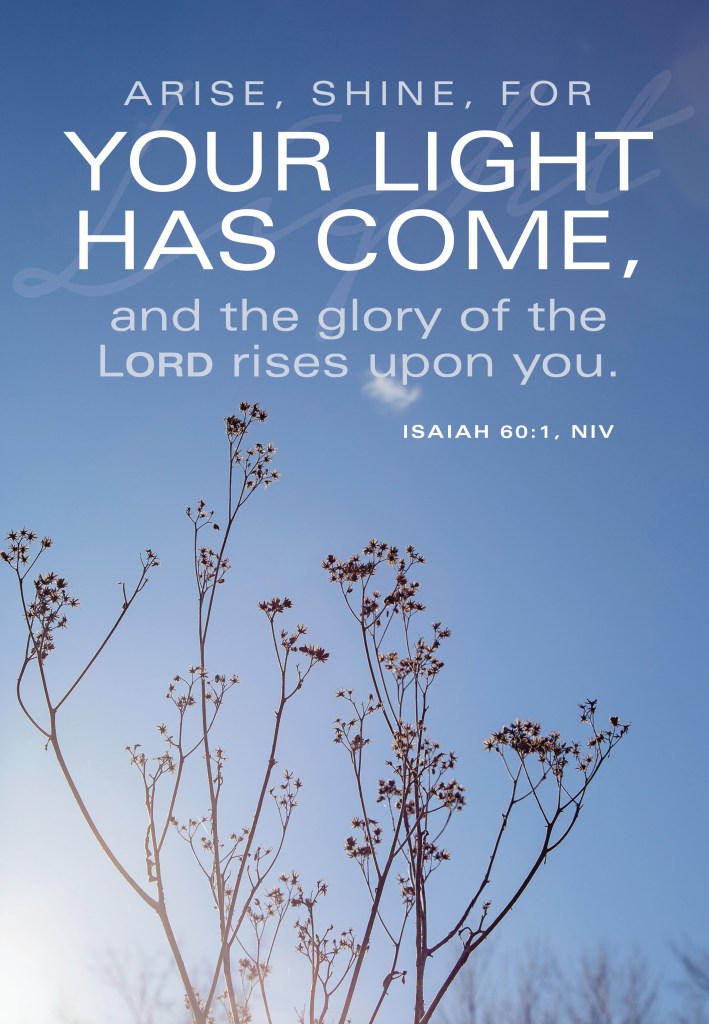
And what is that Light? For Isaiah the prophet, “the glory of the LORD” rises like the sun and brings the Light. Isaiah writes: “Arise, shine, for your light has come, and the glory of the LORD has risen upon you. For behold, darkness shall cover the earth, and thick darkness the peoples; but the LORD will arise upon you, and his glory will be seen upon you” (Isaiah 60:1-2). For the shepherds tending their flocks by night, it was the glory of the Lord shone around them as the heavenly host erupted into joyous song to announce the birth of the Savior, Jesus (Luke 2:8-10). For the Wise Men from the East, it was the miraculous star in the sky that led them to the Christchild.
“[B]ehold, wise men from the east came to Jerusalem, saying, ‘Where is he who has been born king of the Jews? For we saw his star when it rose and have come to worship him.’ When Herod the king heard this, he was troubled, and all Jerusalem with him;” (Matthew 2:1b-3). Here there is a break from the pattern in the Scriptures that we have seen so far. In the Gospel accounts of Matthew and Luke, many people have heard about the coming of the Lord. The Virgin Mary (Luke 1:38, 46-55), Mary’s cousin Elizabeth (Luke 1:42-43), John the unborn Baptist leaping in Elizabeth’s womb (Luke 1:41), Joseph who resolves to take Mary as his wife and to shield her from contempt and scorn (Matthew 1:24), the shepherds from the field who hear about Jesus from the angels then glorify and praise God after they find Him (Luke 2:20)… all of these received the news of the birth of Jesus with thanksgiving… and they were obedient to the commands of the Lord. This is the pattern. This is God’s desire. Herod, however, does not rejoice. Herod is troubled… and all of Jerusalem with him. Herod the Idumaean king of the Jews hears that someone who has the power to take away his throne, the actual King of the Jews, has been born. Herod knows that his claim to the throne is weak because he is not from the House of David… he isn’t even a Jew. Herod has heard the prophecies of old. What if they are true? Are they are actually being fulfilled? So he calls an assembly with all the chief priests and scribes of the people and demands that they tell him, “Where will the Christ be born” (Matthew 2:3-4)? Quoting from the prophet Micah, Herod’s chief priests and scribes answer, “Bethlehem.” In secret, Herod sends the Wise Men to Bethlehem to search out the Child and bring him word of His location (Matthew 2:7-8). The Wise Men intend to find the Child, Jesus, in order to give Him treasures, in order to bow down before Him and worship Him. Herod, on the other hand, intends to find the Child, Jesus, in order to put Him to death. The Wise Men succeed. “And going into the house they saw the child with Mary his mother, and they fell down and worshiped him. Then, opening their treasures, they offered him gifts, gold and frankincense and myrrh. And being warned in a dream not to return to Herod, they departed to their own country by another way” (Matthew 2:11-12). Herod is enraged, and last week we read about the young boys whom Herod killed, the Holy Innocents, in His futile attempt to put Jesus to death before His time. These are two very different reactions to the Light.
Herod is arrogant… prideful… unrepentant… and unbelieving. He would rather kill the Lord than humble himself. If he accepted the reign of Christ, he would have to repent and live according to God’s Law. Instead of killing anyone who gets in his way, he would have to “help and support [his neighbor] in every physical need”. Instead of raising his sons to covet and lust after women, he would have to teach them to “lead a sexually pure and decent life in word and deed” and teach them that “husband and wife are to love and honor each other.” He would have to “fear, love, and trust in God above all things.”
You see… having the Light of Christ shine on you can be a very painful thing. When Paul was on the road to Damascus, commissioned by the chief priests and given the authority to bind and kill Christians, he was encountered by the True Light. The Light, he says, shone brighter than the sun. The Light knocks him down to the ground and blinds him for three days, during which time he does not eat or drink (Acts 9:1-9, 26:12-18). Paul goes on to be sent by God to the Gentiles, “to open their eyes so that they may turn from darkness to light and from the power of Satan to God, that they may receive forgiveness of sins and a place among those who are sanctified by faith in [Jesus]” (Acts 26:18). Paul, all the Jews, all the Gentiles… all people are called to “repent and turn to God, performing deeds in keeping with their repentance” (Acts 26:20). Notice that Paul continues in his repentance as he calls himself “the very least of all the saints” (Ephesians 3:8) and he continues in suffering as a prisoner for Christ. Paul is the Lord’s chosen instrument to proclaim the name of Christ to the people, and the Lord shows Paul how much he must suffer for His name (Acts 9:15-16). Has Paul’s encounter with the True Light been comfortable?
The Light uncovers darkness, and when the light of God’s Word lays bare your utter inadequacy, the only path forward is to repent and bear fruits in keeping with repentance. This was too much for Herod. Herod would rather cling to his earthly throne and set himself up as an opponent to the almighty God. Herod refuses to walk in the light. Herod dies an enemy of Christ. He raises sons after him to be enemies of Christ. But you are not an enemy of Christ. You are baptized. You are a child of God. Christ is your brother. The Lamp of God’s Word is a lamp to your feet and a light to your path (Psalm 119:105). As you are shown your sin, repent and be forgiven. Receive the Holy Spirit to amend your sinful life. Be the Light of Christ in your homes and at work, in your community or wherever you go. Husbands: Love your wives and live with them with understanding, honor them, sacrifice for them, and serve them as Christ does all these things for His Bride, the Church (1 Peter 3:7, Ephesians 5:25-30). Wives: Submit to your husbands as to the Lord as the Church submits to Christ (Ephesians 5:22-24). Parents: Love your children and raise them in the discipline and instruction of the Lord (Ephesians 6:4). Children: obey your parents (Ephesians 6:1). Work diligently in your calling and put on the whole armor of God, the armor of Light. Resist the devil and temptation and repent of your sins each and every day. You have the Light of Life, do not walk in darkness. Repent and believe the Gospel of Jesus, it is for all people… and that includes you!
In the Name of Jesus. Amen

 From the Pulpit