WORSHIP VIDEO LINK (linked after 10:45 AM Service)
WORSHIP AUDIO LINK
SERMON AUDIO LINK
BULLETIN
SERMON TEXT BELOW
Palm Sunday 2026
Immanuel Lutheran Church, Hamilton, Ohio
Pastor Kevin Jud
March 29, 2026
Zechariah 9:9-12, Philippians 2:5-11, Matthew 21:1-17
Sermons online:
Text and Audio: immanuelhamiltonchurch.com click “sermons”
Text: pastorjud.org
Audio: pastorjud.podbean.com
itunes: bit.ly/pastorjud
Full Service Audio: bit.ly/ImmanuelWorship
When the president visits somewhere it is not on the spur of the moment. Forward teams come well in advance. Limos and tactical vehicles are flown in on military transports. Motorcade routes are cleared. Venues are searched and swept for any threats. Bomb sniffing dogs are everywhere. Secret Service coordinates with local law enforcement and emergency plans are made for proximity to a trauma centers and backup vehicles and planes.
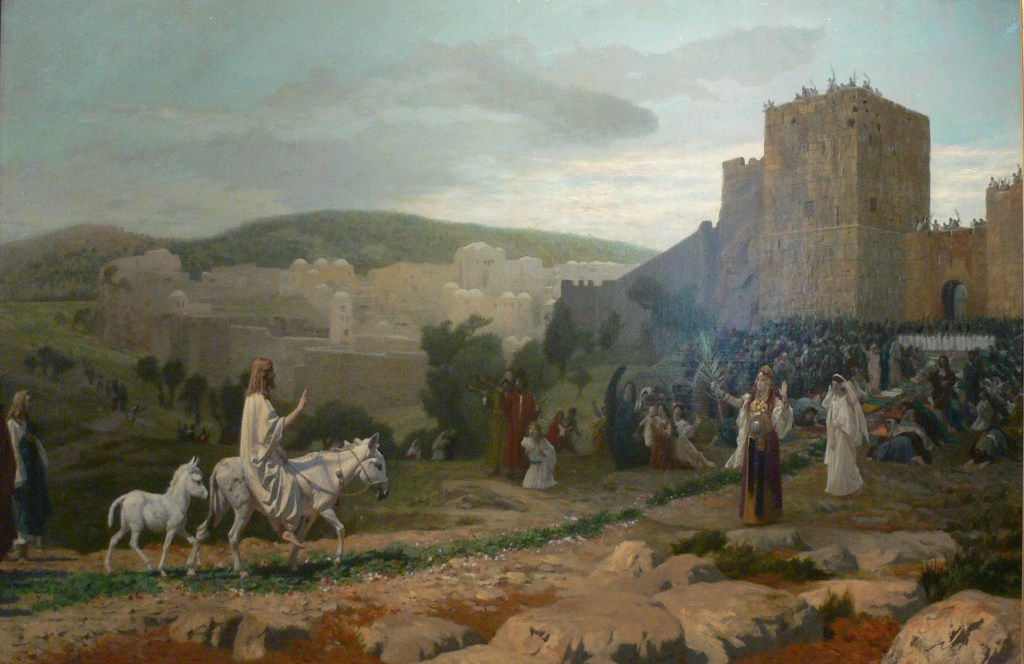
When a king travels, likely similar protocols would be in place. In our Gospel reading today we hear about a King making a visit. The forward team goes on ahead and secures transportation; one female donkey and her colt. That’s it. That is the only preparation. There is no security plan, no emergency plan. However, this trip has been being planned for hundreds of years.
Zechariah prophesied of this visit 550 years in advance… Zechariah 9:9 (ESV) 9 Rejoice greatly, O daughter of Zion! Shout aloud, O daughter of Jerusalem! Behold, your king is coming to you; righteous and having salvation is he, humble and mounted on a donkey, on a colt, the foal of a donkey.”
Zion is another way of saying Jerusalem. Zion was the fortified hill conquered by King David around 1000 BC. O daughter of Zion O daughter of Jerusalem. Rejoice, shout aloud. Your king is coming to you. The King of the Jews is coming. This seems like it has to be a magnificent event. The King will be entering Jerusalem. Will it be a grand procession with the King arriving in a chariot or atop a noble warhorse accompanied by troops of cavalry and foot soldiers? You hear a commotion up the hill. The King is coming! But as you look you see just a single rider – and He looks… not magnificent. He looks kind of ridiculous. It is a grown man bouncing down a steep path astride a small donkey colt. There are no armed horsemen, there is no army. Just a motley crowd of men, women and children surrounding the man waving palm branches and shouting, Matthew 21:9 (ESV) 9 … “Hosanna to the Son of David! Blessed is he who comes in the name of the Lord! Hosanna in the highest!” Something big is happening, but what kind of King is this?
Upon arrival, the King does His own sweep of the venue. But He is not looking for security threats; He is eliminating the established thieves; the thieves who are taking advantage of faithful Jews coming to the temple for sacrifice. These thieves sell “approved” animals at inflated prices and exchange the more valuable Roman coins for less valuable coins they deem “clean” for the Temple. It is believed this sales area in the Court of the Gentiles is called the Bazaar of Annas. Annas is the powerful former High Priest and the father-in-law of the current High Priest Caiaphas. The High Priests are making money off of Jewish pilgrims to Jerusalem by only allowing their “certified” animals and coins, and overcharging for both. The King comes and drives out all who bought and sold in the temple. Matthew 21:13 (ESV) 13 He said to them, “It is written, ‘My house shall be called a house of prayer,’ but you make it a den of robbers.”
The people of Jerusalem hear that the prophet Jesus has come and is at the Temple. Jesus is the one who can heal the sick and make the blind see. Matthew 21:14 (ESV) 14 And the blind and the lame came to him in the temple, and he healed them.” There is no security to keep the King separate from the people, instead, He is surrounded by all those coming for healing.
The chief priests and the scribes, who are already upset about Jesus shutting down the Bazaar of Annas, are indignant that children are crying out to Jesus using messianic language. They are calling Jesus the Messiah as they say, “Hosanna to the Son of David!” “Save us, descendant of King David.” The King has come who is a descendant of King David and an heir to the throne. But what kind of King is this?
The week ahead will show that there is something very different about this King. Very different…as we see when He receives His crown… as we see when He is installed upon His throne with His title above. Jesus of Nazareth, the King of the Jews. The King reigns in suffering and utter humility. What kind of King is this?
This confuses the disciples and it is still confusing today. Jesus is King, but He is not like any other King. St. Paul helps us in our Epistle reading from His letter to the church at Philippi. Philippians 2:5–7 (ESV) 5 Have this mind among yourselves, which is yours in Christ Jesus, 6 who, though he was in the form of God, did not count equality with God a thing to be grasped, 7 but emptied himself, by taking the form of a servant, being born in the likeness of men.” Jesus is the humble servant King. Being a follower of the Servant King is to also be a humble servant.
In our world, being humble is not considered a good thing, but that is what the truth of God’s Word does to you. Christianity is, by nature, humbling, because it shows that you are, by nature, sinful and unclean. It shows that you cannot pay the price for your sin. You cannot do it yourself. You are dependent upon another. This offends your pride, it hurts your self-esteem. You so much want there to be something that you can do to help yourself. As you enter Holy Week there is a temptation to think that in your observance of Holy Week you earn some merit.
Now, this has not happened before, but probably will happen again. Vicar was working on his Wednesday sermon, the same time I was working on this one. We both read a great quote from Martin Luther in the Treasury of Daily Prayer. He quoted it on Wednesday and I will quote it again today as it addresses well our humility as followers of Jesus. Martin Luther writes in a 1519 Lenten essay called “A Meditation on Christ’s Passion,” “Our heart-felt piety and devout participation in the services of this week do not atone for our sins or make us acceptable to God. It is only through faith in the crucified that we are righteous and at peace with God…After man has thus become aware of his sin and is terrified in his heart, he must watch that sin does not remain in his conscience, for this would lead to sheer despair. Just as [our knowledge of] sin flowed from Christ and was acknowledged by us, so we must pour this sin back on him and free our conscience of it. Therefore beware, lest you do as those perverse people who torture their hearts with their sins and strive to do the impossible, namely, get rid of their sins by running from one good work or penance to another, or by working their way out of this by means of indulgences.… You cast your sins from yourself and onto Christ when you firmly believe that his wounds and sufferings are your sins, to be borne and paid for by him, as we read in Isaiah 53 [:6], “The Lord has laid on him the iniquity of us all.” St. Peter says, “in his body has he borne our sins on the wood of the cross” [I Pet. 2:24]. St. Paul says, “God has made him a sinner for us, so that through him we would be made just” [II Cor. 5:21]. You must stake everything on these and similar verses. The more your conscience torments you, the more tenaciously must you cling to them. If you do not do that, but presume to still your conscience with your contrition and penance, you will never obtain peace of mind, but will have to despair in the end. If we allow sin to remain in our conscience and try to deal with it there, or if we look at sin in our heart, it will be much too strong for us and will live on forever. But if we behold it resting on Christ and [see it] overcome by his resurrection, and then boldly believe this, even it is dead and nullified. Sin cannot remain on Christ, since it is swallowed up by his resurrection. Now you see no wounds, no pain in him, and no sign of sin. Thus St. Paul declares that “Christ died for our sin and rose for our justification” [Rom. 4:25].[1]
The great Good News of Jesus’ suffering, death and resurrection is that He has done all that is necessary and you cannot add to it. The humble servant King, out of love, gave everything to save you. He gives it to you completely as a gift. You cannot add to this gift. This humbles your prideful desire to be a part of your own salvation. This humbles you. But, knowing you cannot do anything to accomplish your salvation gets you something beyond comprehension. You get Shalom. You get God’s peace that is beyond understanding. By the blood of Jesus, you are right with God, the creator of the universe. What kind of King is Jesus? He is King of the universe who loves you and gave everything for you that week in Jerusalem.
Your King has come, humble and riding on a donkey to save you. Amen.
[1][1] CPH Treasury of Daily Prayer, pg. 306

 From the Pulpit