WORSHIP VIDEO LINK (linked after 10:45 AM Service)
WORSHIP AUDIO LINK
SERMON AUDIO LINK
BULLETIN
SERMON TEXT BELOW
Epiphany 4 2026
Immanuel Lutheran Church, Hamilton, Ohio
Pastor Kevin Jud
February 1, 2026
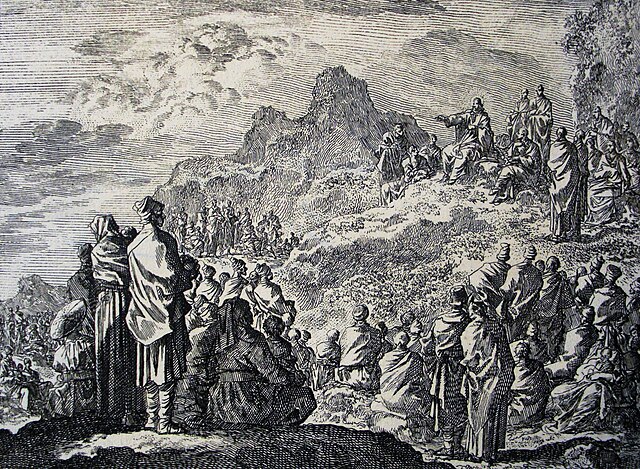
Micah 6:1-8, 1 Corinthians 1:18:31, Matthew 5:1-12
Sermons online:
Text and Audio: immanuelhamiltonchurch.com click “sermons”
Text: pastorjud.org
Audio: pastorjud.podbean.com
itunes: bit.ly/pastorjud
Full Service Audio: bit.ly/ImmanuelWorship
Going to a job interview is stressful. They are going to ask you a lot of questions about your strengths and weaknesses and you want to answer honestly… but maybe not too honestly. When they ask about your weaknesses what do you say? I remember answering this question once, “I have trouble understanding why others don’t work as hard as I do.” Google advises… “choose a real but minor weakness, frame it positively by showing you’re actively improving…making sure it’s not a core skill for the job.”
Imagine for a moment you are at an interview for some kind of a reality show or something, but you are not sure exactly what. The interviewer asks you about your strengths and weaknesses. What do you answer for your strengths? I am smart. I am funny. I am organized. I can solve problems. I am artistic. I work hard. I am a good leader. I am a good communicator. I am good with money. I am well liked. What do you perhaps not say, but you hope they notice? I have a firm handshake. I am well dressed in expensive clothes and shoes.
How would you answer the question about your weaknesses? Maybe…I have difficulty delegating, or I have trouble saying, “No”?
Then you find out that the interview is with God for the reality of being adopted as His child. How do you answer God about your strengths and weaknesses? With God, your strengths can become vulnerabilities. The things that you think impress the world like money and power and fame and beauty and hard work and wisdom — do not impress God. These strengths can be vulnerabilities because it is so tempting to rely on them for your value. It is so tempting to fear, love and trust in your strengths rather than God. And so strengths become vulnerabilities.
For all of us there is the danger of trusting money. Godly stewardship of money is needed to not fall into the trap of loving money. We live in a land of great abundance in which our basic needs are well taken care of. By world standards we all have abundance. Do you see what you have and say, “Look what I have accomplished?” Better to look at what you have, and say, “God has given me great responsibility to manage what He has put in my care.” As a faithful steward of God’s creation you give regular, sacrificial, first-fruits offerings to acknowledge that all you have belongs to God and to prevent greed from getting a foothold.
Love of money is a spiritual danger that can be managed through faithful, generous stewardship. There is a more insidious strength that can become a vulnerability; wisdom. Being intelligent and well educated is viewed very favorably. It seems we are all very impressed by experts with lots of letters after their name. We listen when, “Experts say…” And there is nothing wrong with being smart and educated but there is a danger that you will fall for the devil’s enticement to believe that you are smarter than God. It worked with Eve and it can work with you.
When Paul is writing his first letter to the church in Corinth the Romans and Greeks had many deep thinkers and philosophers pontificating about the meaning of life. There were the Stoics that taught that virtue was the highest good and that living according to reason and nature brings happiness. There were the Epicureans who sought contentment and absence of pain. They believed the soul is material and mortal; just atoms that will disperse upon death. There were also the Sophists who were traveling philosophers who taught rhetoric and philosophy focusing on wit, eloquence and persuasion. They believed truth and morality were relative and not absolute. Jesus’ sacrifice on the cross does not make sense to these wise men of Corinth. Paul calls them out for rejecting the wisdom of God. 1 Corinthians 1:20–21 (ESV) 20 Where is the one who is wise? Where is the scribe? Where is the debater of this age? Has not God made foolish the wisdom of the world? 21 For since, in the wisdom of God, the world did not know God through wisdom, it pleased God through the folly of what we preach to save those who believe.”
The philosophies of our time are not so different and there is still the danger of rejecting anything about God that does not make sense to you. There is the lure to use your wisdom to explain away your sin rather than to repent. There is the pull to rewrite God’s Word so it is in line with your thinking. It is very popular in our age to believe you are smarter than God and elevate your intellect over Scripture.
When I got out of college I was pretty sure I knew what the Bible taught about different things because I was convinced that the Bible pretty much taught what I believe. Then I actually read the Bible and I had a startling discovery; there were teachings in the Bible that went against my personal beliefs. What should I do? I had to decide. Who is right? Me? Or God?
This is an ongoing temptation. I want to make God make sense to me. I had a bit of a crisis on my vicarage because I realized that I did not understand Holy Communion. How can the bread be the Body of Christ? How can the wine be the Blood of Christ? It does not make sense. Then I came to an epiphany. God does not have to make sense to me. It is true because Jesus said it is true. “Matthew 26:26–28 (ESV) 26 …“Take, eat; this is my body.” 27 …“Drink of it, all of you, 28 for this is my blood of the covenant, which is poured out for many for the forgiveness of sins.” God does not need to make sense to me. It makes sense that God does not make sense because He is the creator and I am the creation.
The Lord declares in…Isaiah 55:8–9 (ESV) 8 For my thoughts are not your thoughts, neither are your ways my ways, [declares the Lord]. 9 For as the heavens are higher than the earth, so are my ways higher than your ways and my thoughts than your thoughts.”
In this world our default idea about receiving eternal life is too often the same as the rich young man in… Matthew 19:16 (ESV) 16 …“Teacher, what good deed must I do to have eternal life?” It is the wrong question. Jesus forgives — not because of anything in you — but because of Christ crucified for you. 1 Corinthians 1:22–25 (ESV) 22 For Jews demand signs and Greeks seek wisdom, 23 but we preach Christ crucified, a stumbling block to Jews and folly to Gentiles, 24 but to those who are called, both Jews and Greeks, Christ the power of God and the wisdom of God. 25 For the foolishness of God is wiser than men, and the weakness of God is stronger than men.” God does not have to make sense.
Religious movements of many sorts reject the sufficiency of Jesus on the cross for forgiveness because they believe they need to do something to be a part of their own salvation. Church bodies reject infant baptism because it does not make sense to them that an infant can have faith. Churches reject the real presence of the Body and Blood of Jesus in, with and under the bread and the wine of Holy Communion for the forgiveness of sins because it does not make sense that Jesus is at the right hand of the Father and on the altar at the same time.
We are tempted by the devil to use wisdom and cleverness and eloquent language to change the Word of God to fit our own desires and the understandings of the world. When the E.L.C.A. rejected that Jesus is the only way to salvation they claimed their new policy’s text “undergirds a posture of curiosity and humility” as the ELCA seeks to “learn from and engage” their inter-religious neighbors.” One delegate argued that Jesus said, John 14:6 (ESV) 6 …“I am the way, and the truth, and the life. No one comes to the Father except through me.” To which a pastor responded, “Our God is big enough for our family to include all of these interfaith siblings. Our God is big enough to admit that we do not know everything there is to know.” The policy to reject Jesus as the only way to salvation was passed by a vote of over 97%.
Using the wisdom of the world, denominations have proudly endorsed clearly condemned sin because they reason that, “life is complicated,” and because of complications, sin must be okay. Abortion on demand is celebrated. Homosexuality and transgenderism is encouraged. They use pretty words like, “we need to engage in “serious moral deliberation,” or, “this doesn’t violate Jesus’ principal of unconditional love and forgiveness.” Or because, Genesis 1:27 (ESV) 27 …God created man in his own image…”. Using half a verse and some nice words they reject all scripture that does not fit their ideas. Indeed, God did create man in His own image in Genesis 1, and then Man fell into sin in Genesis 3. To rationalize sin by saying God made me in His image could be used for any sin. “I like to steal. God made me this way. Even though the 7th Commandment say, “You shall not steal,” it is okay. God made me in His image.” Those using this verse to support transgenderism generally don’t use the whole verse. Genesis 1:27 (ESV) 27 So God created man in his own image, in the image of God he created him; male and female he created them.”
We too can fall under the temptation to use our wisdom to try to redefine and justify our sin. My refusal to forgive is just righteous anger. We are going to get married, so living together now is just fine. My hatred of others is because of my loyalty to God. My private lusts don’t hurt anyone. My anger is just who I am. My sin is okay — because I say it is okay.
Back to your interview with God. You are asked to list your strengths and weaknesses. What do you say? It really is not hard to answer. You already did – just 0this morning on your knees as we began the Divine Service. You confessed that you deserve punishment now and forever and you do not deserve to be forgiven. You confessed you need Jesus to be your Savior. You declared before God that you have no strengths, you cannot rely on yourself, you are weak, lowly, poor in spirit, hungering and thirsting for things to be right. You are spiritually bankrupt – and you are blessed by God now and for eternity. You are saved by the power and wisdom of God through Christ on the cross for you. In the waters of baptism, God washed you clean and adopted you as His beloved child — not because of your strengths — but because of His.
1 Corinthians 1:28–29 (ESV) 28 God chose what is low and despised in the world, even things that are not, to bring to nothing things that are, 29 so that no human being might boast in the presence of God.
This flies in the face of the world’s understanding that you must rely on your own strengths. You want to think you can count on yourself, but you cannot. You rely on the Father’s gift of forgiveness in the blood of Jesus. 1 Corinthians 1:30–31 (ESV) 30 And because of him you are in Christ Jesus, who became to us wisdom from God, righteousness and sanctification and redemption, 31 so that, as it is written, “Let the one who boasts, boast in the Lord.”
What are your strengths and weaknesses? Your strength is the word of the cross which is the power of God that overcomes your weakness. That is why we preach Christ crucified. Amen.
 From the Pulpit