WORSHIP VIDEO LINK (linked after 10:45 AM Service)
WORSHIP AUDIO LINK
SERMON AUDIO LINK
BULLETIN
SERMON TEXT BELOW
Daniel English
February 15, 2026
Sermon – Transfiguration
Exodus 24:8-18; 2 Peter 1:16-21; Luke 9:28-36;
Glorious Now, But Not Yet
In the Name of the Father, and of the Son, and of the Holy Spirit. Amen.
“If you could invite any three people, living or dead, to a dinner party, who would you pick?” This sort of personal hypothetical has been popular since parlor games in the Victorian Era, maybe before. In the 60’s television hosts David Frost and Barbara Walters brought it from print media into television. Your answer can show-off a little bit of your history prowess. Politicians and other prominent members of society reveal who their influences are, who they respect, or what people they find to be most important or interesting. Former President Barack Obama was asked this question during his book tour, and he said: Abraham Lincoln, Martin Luther King Jr., and Nelson Mandela. The tech billionaire Elon Musk, when asked in a recent interview answered: William Shakespeare, Benjamin Franklin, and Nikola Tesla. You can only imagine what kind of conversation these groups of three people from different times would say to one another after being ripped out of their historical context and placed at a dinner party with you.
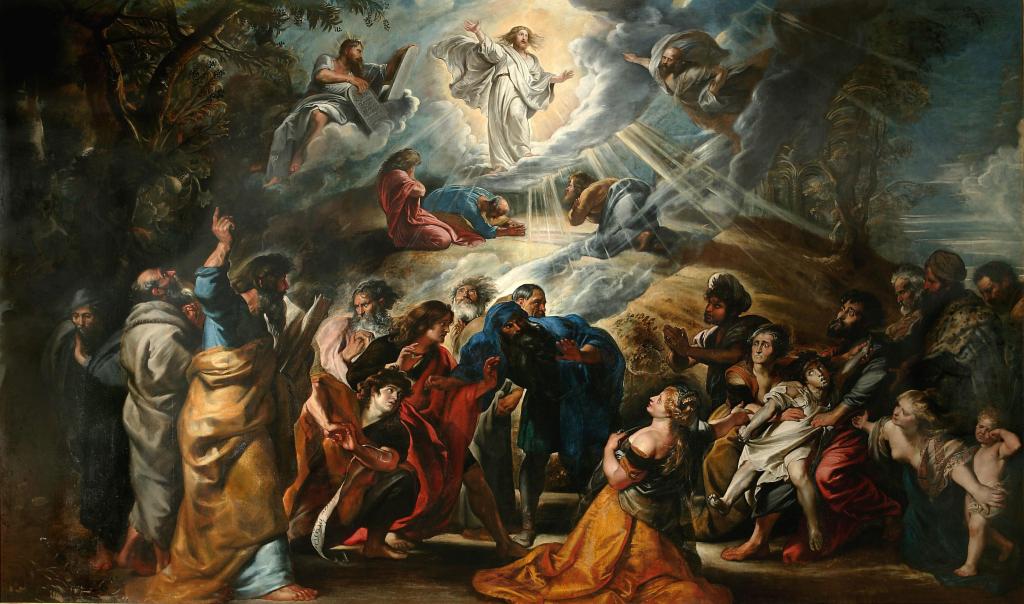
Our Holy Gospel reading for today puts us in a situation similar to these hypothetical dinners. How about Moses, Elijah, and Jesus Christ? Today we hear about the Transfiguration of Our Lord, and it is one of the great mysterious events of the Bible. Jesus takes His inner circle: Peter, James, and John, up to a mountain top and is transfigured before their eyes. Matthew records that Jesus’ face “shone like the sun” (Matthew 17:2). His clothes become dazzling white. And then another detail included in all three gospel accounts of the Transfiguration: Jesus is joined on top of the mount by Moses and Elijah.
Approximately 1,500 years before th birth of Christ, Moses led God’s people out of slavery in Egypt, he received the Law on top of Mount Sinai, and by the power of the Holy Spirit he wrote down the first 5 books of the Bible, known as “Torah” or “The Law.” When Moses died —just outside of the Promised Land— he was laid to rest by God Himself. Nobody but God knows where the body of Moses was buried.
Elijah, about 850 years before the birth of Christ, was fed by ravens in the wilderness (Elijah didn’t eat the ravens… but they were sent by God like an ancient meal delivery service to bring him bread and meat every morning and every evening). Elijah raised a widow’s son from the dead in Zarephath. Elijah confronted Ahab, the wicked King of Israel, and stood alone against 450 priests of Baal in a showdown that resulted in their slaughter. Elijah was one of the few men who never had to face death, his body was never found because God took him directly into heaven by a whirlwind.
Moses and Elijah are two of the most notable and powerful prophets of the Old Testament. Both of these men were extremely important to the bible-believing community, and at different times in history, both of these men heard God’s Word spoken to them directly on top of a mountain. Now they are on top of the Mount of Transfiguration having a conversation with Jesus. What are they talking about? Well we can do a whole lot more than just imagine it, thanks to Luke’s account! Luke tells us something neither Matthew nor Mark record:
“And behold, two men were talking with him, Moses and Elijah, who appeared in glory and spoke of his departure, which he was about to accomplish at Jerusalem” (Luke 9:30-31). Jesus, Moses, and Elijah are speaking about Christ’s departure. What departure? The Greek can help us here because you know the word: ἔξοδος. The Greek word for “departure” is exodus. There isn’t a biblically literate, Greek-reading person in the Levant who could hear the word exodus without thinking about Moses leading the 12-mile train of Hebrews out of Egypt and slavery toward the Promised Land. Hopefully you think of that too, but this is Jesus’ exodus we’re talking about, not Moses’. The liberating work of God through Moses and the plagues which culminated in the Passover that spared God’s people from death and released them from the yoke of Egyptian slavery is nothing to us until it finds its fulfillment in the redemptive work of Jesus Christ on the Cross. The ancient exodus from Egypt that Moses records in the Scriptures foreshadows our exodus —our departure— from sin death and the devil. Just as God with His mighty Right Hand delivers the Hebrews from their Egyptian taskmasters, so also God with His mighty Right Hand Man, Jesus Christ, delivers us from our cruel taskmaster, the devil, unto life everlasting. Moses is here representing the Law, and Elijah the prophets. Together they are witnesses to the fact that all the Law and all the Prophets are fulfilled in the Person and Work of Jesus Christ. So Jesus, Moses, and Elijah are our special dinner guests, and they are in conversation about the mighty work of salvation that Jesus is about to accomplish. And He did accomplish it for us.
But for Peter, James, and John on the Mount of Transfiguration, these things have yet to be accomplished. Peter, James, and John see this amazing glimpse of the Glory of Our Lord, and they love it. Peter recognizes the men with Jesus and says, “Master, it is good that we are here” (Luke 9:33). He wants to make tents for all three and stay for a while. Peter is misguided. He says it is good to be here on this Mount of Transfiguration, but Jesus will show Him that what He is about to do is better and necessary. Peter doesn’t yet understand the theology of the cross. And so, the cloud descends, the Father declares from heaven, “This is my Son, my Chosen One; listen to him” (Luke 9:35)! Then the dazzling light of the Transfiguration fades, and Our Lord, glorious now, but also not yet, begins on the road to the cross because “suffering comes before glory” (Just Concordia Commentary p###). After Jesus descends the Mount of Transfiguration, He will “set his face to go to Jerusalem” (Luke 9:51). Jesus has begun to tell His disciples that He will go to Jerusalem where He “is about to be delivered into the hands of men” (Luke 9:44)… where He “must suffer many things and be rejected by the elders and chief priests and scribes, and be killed, and on the third day be raised” (Luke 9:22). The Transfiguration is a point of transition between Christ’s ministry in Galilee and His journey to Jerusalem… His journey to the cross.
This is confusing to the disciples, even those in Jesus’ inner circle. Here on top of the mountain, Jesus is resplendent and glorious, and it’s heaven on earth. The disciples don’t understand that Jesus still has to suffer and die. We shouldn’t be too hard on Peter! If it weren’t for God’s revealed Word telling us that Peter didn’t know what he was saying, we would all nod in agreement. “Yes, it is good, Lord, to be here!” You might be tempted to review the list of Peter’s errors and scoff at him: “Foolhardy Peter, doubting the Lord’s instructions with the fishing net (Luke 5:5), taking his eyes of Jesus and sinking into the Sea of Galilee (Matthew 14:30), rebuking the Lord on the way to Jerusalem (Matthew 16:22), refusing to have his feet washed in the upper room (John 13:8)… even denying the Lord on the night of His crucifixion (Luke 22:54-62)…” It seems Peter is somewhat slow to understand.
But how do you respond when Jesus calls you away from present glory to suffering like His? Do you understand the theology of the cross? Christ says, “If anyone would come after me, let him deny himself and take up his cross daily and follow me” (Luke 9:23). Do you take up your cross daily, or do you despise it and chafe at the Lord’s authority? Christ says, “For whoever would save his life will lose it, but whoever loses his life for my sake will save it” (Luke 9:24). Do you willingly lose your life in Christ, or do you cling to your life and build it on your possessions or your career, or your family… almost anything else? Jesus’ movement from His Transfiguration, bright and glorious, to the dark and bloody cross is a holy example for you as you walk in the way from your baptism, the washing of regeneration, to your death. Through the water and the Word of your baptism you receive faith, the Holy Spirit, the forgiveness of sins, and all the wonderful gifts that Christ promises to His Church. You are joined to Christ and your sinful self is put to death… drowned, and you rise up to walk in the newness of life. But then… you go on to suffer.
Today little Euphemia [will be baptized / was baptized] and she [will be / is] clothed with the dazzling righteousness of Christ… today, it is good Lord, to be here! Euphemia [will be / is ] made glorious today… you all are made glorious in your baptism… but also… not yet. First, Euphemia, and all of us, will suffer. She will face temptation, heartbreak, grief, and sorrow. She will suffer under my flaws as a father, and she will battle against the devil, the sinful world, and her own sinful flesh. This is what Christ has called each and every single one of us to. It seems daunting, maybe you’re overwhelmed, but my brothers and sisters in Christ, take heart: Jesus Christ has overcome the devil, the sinful world, and your sinful flesh. Chrit does the battling for you, and He has won the victory. His suffering once for all earns mercies that are given to you anew every single morning. Because of Christ’s departure, we can depart this service and this life in peace. God’s Word has been fulfilled.
Today we say goodbye to our “Alleluias” until Easter. We change our paraments to purple, and then to black. Some of you fast also from meat or facebook or some other good gifts throughout Lent. We suffer a little bit to train ourselves when deeper suffering comes. But you must remember that your suffering is only for a time, and “the sufferings of this present time are not worth comparing with the glory that is to be revealed to us” (Romans 8:18). In our baptism we are glorious with Christ now, but also not yet. For now we walk in danger and trials all the way, until that final day when He comes again in glory to judge the living and the dead, to make all things new, and to bring us into his heavenly kingdom where we will stand in the Glorious Light of Christ forever.
In the Name of Jesus. Amen.
 From the Pulpit