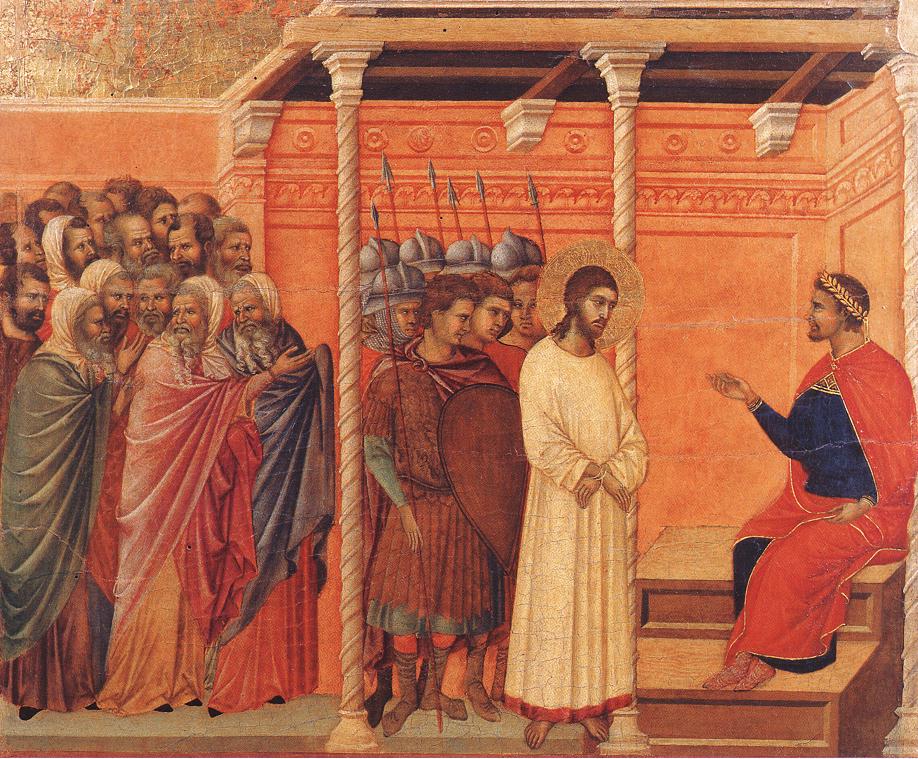
Duccio di Buoninsegna – Christ Before Pilate Again
WORSHIP VIDEO LINK
WORSHIP AUDIO LINK
SERMON AUDIO LINK
BULLETIN
SERMON TEXT BELOW
Daniel English
March 11, 2026
Sermon – Lent 5 – Midweek Wednesday
Isaiah 53:4-7; Matthew 27:1-26;
Like Barabbas: Guilty but Freed by Christ
In the Name of the Father, and of the Son, and of the Holy Spirit. Amen.
“When morning came.”[1] In case we would forget as we turn the page from the 26th chapter of Matthew’s Gospel to the 27th, these words remind us that Jesus has been struck, spit on, slapped, and mocked all night. After the Last Supper with His disciples the night before —the Last Supper before His death— Jesus is betrayed and arrested —falsely arrested— while praying in the Garden of Gethsemane on the Mount of Olives.[2] Jesus is beaten and abused by Caiaphas and his council after they conduct a sham trial and falsely convict Him.[3] Jesus is betrayed by one… and abandoned by the rest of his disciples, including, finally, by Peter.[4] Jesus has had a very long night. This is where our Gospel reading begins. Morning breaks and the Son of Righteousness rises to be bound, and led away, and delivered over to Pilate in order that He be sentenced to death.[5]
As the light of day exposes the sinful works of man, God’s Word gives us three, negative examples from which we can learn. Three examples of what NOT to do. First, the betrayer, Judas, who is in deep despair over his sins to the point of taking his own life. Judas is sorry for his sins —he has contrition— but he does not have faith in God’s mercy and forgiveness. Second, the governor, Pontius Pilate, who denies justice and rejects the truth for the sake of his own personal safety and success. Pontius Pilate does not believe that Jesus is guilty or deserving of death —he has conviction— but he lacks the courage to do what is right. Third, the chief priests, the elders, and the crowds who demand that Jesus be crucified. They are envious and wrathful. They are blind to who Jesus is and blind to their own sin. The actions of these three, Judas, Pontius Pilate, and the crowds result in the release of a notorious criminal, Barabbas, while our Lord Jesus Christ is sent off to die. But what these three meant for evil, God meant for good.
There isn’t much good at all that can be said about Judas Iscariot. He is an unbelieving[6] thief[7] who agrees to betray Jesus in exchange for 30 pieces of silver.[8] Even Jesus calls him “a devil.”[9] Judas receives his plan to betray Jesus from the devil himself.[10] But even Judas, when he sees that Jesus is condemned, is filled with regret. He doesn’t even want the money he received as a reward. As he tries to return it he says, “I have sinned by betraying innocent blood.”[11] Judas has contrition, but he doesn’t have faith. The reformers knew very well that proper repentance consists of two parts: contrition and faith (Ap XIIa 1).[12] It is not enough for a person to know and regret his sin. In his Meditation on Christ’s Passion, Luther writes, “After man has thus become aware of his sin and is terrified in his heart, he must watch that sin does not remain in his conscience, for this would lead to sheer despair… Therefore beware, lest you do as those perverse people who torture their hearts with their sins and strive to do the impossible, … [to] get rid of their sins by running from one good work … to another… if you … presume to still your conscience with your contrition and penance, you will never obtain peace of mind, but will have to despair in the end.”[13] And this is exactly what Judas does. He is in such despair that he takes his own life. When you are convicted of your sin, don’t wallow in your guilt like Judas. This only leads to despair. Instead, look to Jesus in faith and see His loving heart. Martin Luther continues, “We know God [rightly] when we grasp him not in his might or wisdom… but in his kindness and love. Then faith and confidence are able to exist, and then man is truly born anew in God.”[14]
Pontius Pilate is the governor of Judea. He is a Roman ruler serving under emperor Tiberius in an area predominately populated by Jews. Judea is a difficult province to govern. Various Jewish sects: the Pharisees, the Sadducees, the Zealots, the Yahad, and the Hellenized Jews are all in tension with one another,[15] not to mention conflict with the Samaritans and Gentiles in the neighboring regions. Now the Jews seemingly come together in agreement: Jesus is causing problems, and he needs to be killed. Pilate is amazed by Jesus’ silence in response to the false charges brought before him,[16] he understands that Jesus has been delivered up out of envy,[17] and he doesn’t find Jesus guilty of any crime deserving death.[18] Jesus is innocent, and Pontius Pilate knows that Jesus is innocent… but he doesn’t have the courage to stop his crucifixion. To prevent Jesus’ death would risk public unrest that could mean the end of his political career or even his life. Foolishly, Pontius Pilate fears those who kill the body but cannot kill the soul. His encounter with the Word made flesh does not yield fruit, but —like a sprout with no root or choked out by thorns— he chooses to declare himself innocent in one moment, then scourges Jesus and delivers him over to be crucified in the next.[19] It is true, we are not justified by our good works, and so Pilate having courage wouldn’t have saved him, but we can’t “imagine a kind of faith that can exist and abide with, and alongside of, a wicked intention to sin and to act against conscience. But after a man has been justified through faith, then a true living faith works by love (Ep III 11).”[20] Instead of cowering like Pilate, we are to hold fast to the faith and encourage one another to love and good works.[21]
Finally, the chief priests and the elders with the crowd they persuaded to destroy Jesus. It would be hard to believe that this crowd could be the same people who just a week ago on Palm Sunday shout, “Hosanna to the Son of David! Blessed is he who comes in the name of the Lord! Hosanna in the highest!”[22] Whether fickle followers of Jesus or a hand-picked crowd by the Jewish elites[23], we see a disturbing showing of the depths of human evil. It had become a regular custom for Pilate to release a prisoner at the feast of Passover. The crowd is given the choice between Jesus, an innocent man, and Barabbas, a notorious criminal. The crowd presses for Barabbas to be released, and for Jesus to be put to death. “Pilate saw that he was gaining nothing, but rather that a riot was beginning, he took water and washed his hands before the crowd, saying, ‘I am innocent of this man’s blood; see to it yourselves.’ And all the people answered, ‘His blood be on us and on our children!’”[24] The irony. “His blood be on us and on our children.” If only the crowds understood the power of Jesus’ blood they would cry out instead, “Deliver me from bloodguiltiness, O God, O God of my salvation, and my tongue will sing aloud of your righteousness.”[25] The chief priests, the elders, and the crowds present at Jesus’ trial before Pilate are spiritually blind. They are spiritually dead. They are the final negative example set before us in today’s reading, and they choose a criminal Barabbas to be released instead of the perfect Lamb of God. But what they meant for evil, God meant for good.
The Scriptures in many places invite the reader to imagine himself as part of the Biblical narrative. Maybe you see yourself in the Israelites as they are rescued by David’s courageous and decisive victory over Goliath, fearful and reticent the Israelites wait on David to do what they are unable to do[26]… just as we wait on the Lord Jesus Christ to do what we are unable to do. Maybe you see yourself in the unnamed disciple with Cleopas on the Road to Emmaus as Christ unveils Himself in the Old Testament, slow to understand and believe the two disciples feel their hearts burning within them as they learn from the Lord until they finally come to know Him in the breaking of the bread[27]… just as our understanding and faith deepen by the Power of the Holy Spirit working through the Word and is sustained and strengthened at the Lord’s Supper. Maybe in Joseph’s brothers as they receive forgiveness from Joseph so surprising that they can hardly believe it is real… just as we hear from Pastor an absolution of all our sins that sounds too good to be true, but it is true. In today’s reading, I invite you to see yourself in Barabbas… a sinner… imprisoned, unworthy, and guilty. And yet, Christ suffers death on the cross and Barabbas is released, free and uncondemned.
Luther calls this the “wonderful exchange.” “That is the mystery which is rich in divine grace to sinners: wherein by a wonderful exchange our sins are no longer ours but Christ’s, and the righteousness of Christ is not Christ’s but ours. He has emptied Himself of His righteousness that He might clothe us with it, and fill us with it. And He has taken our evils upon Himself that He might deliver us from them… in the same manner as He grieved and suffered in our sins, and was confounded… we rejoice and glory in His righteousness.”[28]
Be sorry for your sins, but don’t stop there and despair. Have faith in Jesus for deliverance… Believe in the righteousness, and innocence, and blessedness of Jesus, but don’t stop there. Have the courage to live out your convictions in love toward God and one another… Do not be spiritually blind, refusing to see your own sin or to know who Jesus is, but repent and believe the Gospel.
“For all have sinned and fall short of the glory of God, and are justified by his grace as a gift, through the redemption that is in Christ Jesus, whom God put forward as a propitiation by his blood, to be received by faith. This was to show God’s righteousness, because in his divine forbearance he had passed over former sins. It was to show his righteousness at the present time, so that he might be just and the justifier of the one who has faith in Jesus.”[29]
We all are like Barabbas… guilty… but freed by Christ. In Christ, we are innocent and free.
In the Name of Jesus. Amen.
[1] Matthew 27:1a
[2] Matthew 26:20-29; 26:36-55;
[3] Matthew 26:57-68
[4] Matthew 26:69-75
[5] Matthew 27:1-2
[6] John 6:63-64
[7] John 12:4-6
[8] Matthew 26:14-16
[9] John 6:70-71
[10] Luke 22:1-6; John 13:2
[11] Matthew 27:4
[12] McCain, Paul Timothy et al., eds. Concordia: The Lutheran Confessions; A Reader’s Edition of the
Book of Concord. 2nd ed. St. Louis: Concordia, 2006.
[13] Martin Luther, “A Meditation of Christ’s Passion,” in Luther’s Works, Vol. 42: Devotional Writings I, ed. Jaroslav Jan Pelikan, Helmut T. Lehmann, and Christopher Boyd Brown (Philadelphia: Fortress Press, 1969), 6–14.
[14] Ibid.
[15] Bryan Stecker, “Episode Three – Understanding the Jewish Religion with Jacob Benson,” November 13, 2023, YouTube video, 0:42:59, https://www.youtube.com/watch?v=-Z_HzijjDq4.
[16] Matthew 26:14
[17] Matthew 27:18
[18] Luke 23:4, 22
[19] Matthew 27:24-26
[20] McCain, Paul Timothy et al., eds. Concordia: The Lutheran Confessions; A Reader’s Edition of the
Book of Concord. 2nd ed. St. Louis: Concordia, 2006.
[21] Hebrews 10:23-25
[22] Matthew 21:9
[23] Maier, Paul L., “Commentary: The Most Overlooked Verse in the Bible,” Reporter, February 5, 2007, https://reporter.lcms.org/2007/commentary-the-most-overlooked-verse-in-the-bible/.
[24] Matthew 27:24-25
[25] Psalm 51:14
[26] 1 Samuel 17
[27] Luke 24:13-35
[28] Luther, Martin. Werke (Weimar, 1883), 5:608
[29] Romans 3:23-26
 From the Pulpit