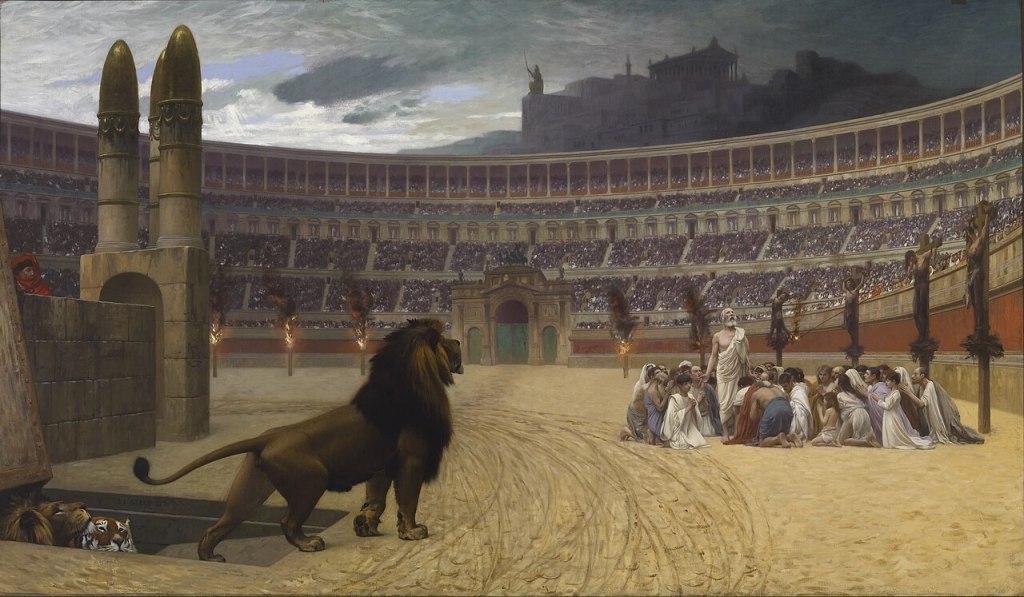
By Jean-Léon Gérôme – Walters Art Museum: Home page Info about artwork, Public Domain, https://commons.wikimedia.org/w/index.php?curid=171182844
WORSHIP VIDEO LINK (linked after 10:45 AM Service)
WORSHIP AUDIO LINK
SERMON AUDIO LINK
BULLETIN
SERMON TEXT BELOW
Daniel English
August 23, 2026
Sermon – Thirteenth Sunday after Pentecost – Proper 16
Isaiah 51:1-6; Romans 11:33-12:8; Matthew 16:13-20;
A Living Sacrifice
“I appeal to you therefore, brothers, by the mercies of God, to present your bodies as a living sacrifice, holy and acceptable to God, which is your spiritual worship. Do not be conformed to this world, but be transformed by the renewal of your mind, that by testing you may discern what is the will of God, what is good and acceptable and perfect.”
In the Name of the Father, and of the Son, and of the Holy Spirit. Amen.
Being a Christian is difficult. You cannot rely on yourself. You must rely on Jesus Christ. The appeal made in our epistle is hard to do: “Present your bodies as a living sacrifice, holy and acceptable to God, which is your spiritual worship.” St. Paul writes these words to the Christians in Rome in the year AD 55. A little over ten years later, both he and St. Peter will be put to death under the Roman Emperor Nero. St. Peter is crucified upside down and St. Paul is beheaded… Present your bodies as a living sacrifice.
In the year AD 64, a large fire breaks out in Rome. Emperor Nero blames the Christians. This is one of the first recorded persecutions of Christians in the Roman Empire. Tacitus, a Roman historian, writes, “Nero fastened the guilt and inflicted the most exquisite tortures on a class hated for their abominations, called Christians by the populace. Christus, from whom the name had its origin, suffered the extreme penalty during the reign of Tiberius at the hands of one of our procurators, Pontius Pilate.” Tacitus is a Roman and a pagan, and he describes Christians and Christianity as “superstitious” and “hateful.” Sound familiar? His writing shows how Christians in the first century were thought of by the Romans. He also describes the awful things that were done to the Christians: About their punishments he writes, “An immense multitude [of Christians were] convicted… mockery of every sort was added to their deaths. Covered with the skins of beasts, they were torn by dogs and perished, or were nailed to crosses, or were doomed to the flames and burnt, to serve as a nightly illumination, when daylight had expired.” …Present your bodies as a living sacrifice.
The persecution under Emperor Nero was the first of many over the next 300 years. It wasn’t until the fourth century that Christianity was granted some kind of toleration under the law. Over and over again, Christians were brought before various officials and asked to give up their faith and worship false gods… to renounce Jesus Christ and worship Caesar as lord instead… or else suffer death. During the persecutions in the second century, under Emperors such as Trajan and Marcus Aurelius, our brothers and sisters in the faith started responding with a simple, but powerful phrase. When brought before pagan authorities demanding that they renounce the faith or die, they would respond, “Christianus sum.” “I am a Christian.” …Present your bodies as a living sacrifice.
The church cherishes a multitude of examples of Christians being put to the test, keeping the faith. Christians who placed their faith in Jesus above their very lives. Have you ever thought about how you might respond to a persecution like that? Give up the faith, or die. I know I have. Here is what our confirmands promise in the Rite of Confirmation, or what you promise when you are brought into church membership through a public confession of your faith. You promise to present your bodies as a living sacrifice.
Pastor asks, “Do you intend to hear the Word of God and receive the Lord’s Supper faithfully?” And you respond, “I do, by the grace of God.”
Pastor asks, “Do you intend to live according to the Word of God, and in faith, word, and deed to remain true to God, Father, Son, and Holy Spirit, even to death?” And you respond, “I do, by the grace of God.”
Finally, Pastor asks, “Do you intend to continue steadfast in this confession and Church and, if necessary, suffer all, even death, rather than fall away from it?” and you say: “I do, by the grace of God.”
Which of us has not at some point violated this vow?
In a certain way, the test faced by the early Christians was easier because it was obvious… what they were being asked to do and what they were giving up was crystal clear. “You believe Jesus is God, and we want you to stop doing that. If you don’t, we’re going to kill you.” The Christians under Roman rule were asked to give up the faith all at once, and the consequences were black and white! Sometimes, Satan is a lot more subtle than that. Sometimes, it feels like it gets a little gray.
What is it that you have been asked to give up? What consequences have been trying to avoid? What aspects of Christ’s teaching have you compromised in order to keep from feeling awkward at work? … or to keep things peaceful between friends? … or to keep things easy at family get-togethers? How practiced are we, really, at enduring any kind of hardship for the sake of our Christian faith?
Paul says, “Do not be conformed to this world, but be transformed by the renewal of your mind,” but we have conformed to this world, haven’t we? Things that would have made Christians from generations ago shocked and disgusted have become so normal to us. This isn’t just about the dark side of the internet, but preserving the sanctity of the marriage bed, and modesty in our dress and our speech and our conduct. This isn’t just about abortion, but about being open to the gift of life in marriage and receiving children as a heritage from the Lord… taking care of them and teaching them to pray and read the Bible at home. This isn’t just about divorce, but about caring for our spouses and working together in order to be a picture of Christ and His Bride, the Church, to the world. It’s about honoring our parents and taking care of them. It’s about praying for one another instead of talking behind one another’s backs. It’s about helping one another instead of being envious. It’s about patience instead of hasty anger, sobermindedness instead of drunkenness, and prayer in all things instead of anxiety and worry. Lord have mercy on us all and renew our hearts and our minds!
Paul continues in our epistle, “For by the grace given to me I say to everyone among you not to think of himself more highly than he ought to think, but to think with sober judgement, each according to the measure of faith that God has assigned.” Don’t think of yourself too highly. Humble yourself. Be honest about the faith God has given to you. What is it that you are struggling with? What things are you able to do according to the measure of faith that God has assigned? And most importantly, know that faith and victory over your struggles come to you by the grace of God.
Our reading today begins with a great doxology to our God: “Oh, the depth of the riches and wisdom and knowledge of God! How unsearchable are his judgments and how inscrutable his ways!
‘For who has known the mind of the Lord, or who has been his counselor?’
‘Or who has given a gift to him that he might be repaid?’
For from him and through him and to him are all things. To him be glory forever. Amen.”
This great praise follows immediately after our reading last week, in which we learn that God has had mercy on all through Jesus Christ. This praise is a response to the very good news that the One who has the reason and authority to put us to death has instead shown us mercy. God has not rejected His people, the Jews or the Greeks, but He has had mercy on all whom He has created. God has given this grace and mercy to us all as a gift.
Now, Tacitus is a pagan, but notice that he does not deny the existence of Christ. About our Lord he writes, “Christus, from whom the name had its origin, suffered the extreme penalty during the rain of Tiberius at the hand of one of our procurators, Pontius Pilatus.” He is talking about Jesus Christ, who “suffered under Pontius Pilate, was crucified, died and was buried.” So when someone asks you, “what evidence is there outside of the Bible that Jesus was real and died on the cross.” You can say, “Tacitus the Roman Historian wrote about it too.” But thanks to the Word of God, we know a lot more about Jesus Christ. We know that He is the only Son of God and He is our Lord. We know that He was “conceived by the Holy Spirit, born of the Virgin Mary,” and we know that after His crucifixion He rose from the dead! Jesus is the true living sacrifice, and by baptism and faith we are bonded to Christ’s death and share in His resurrection and victory over sin, death, and the devil… all by GRACE. “Who has given God a gift that he might be repaid?” No one. God is the one who gives the gift.
Look again at our epistle reading. In verse 1 and verse 3, Paul is appealing to us by what? By the mercy and grace of God. “I appeal to you therefore… by the mercies of God.” “For by the grace given to me.” It is only by faith in Christ that we are made holy and acceptable to God, and it is only because we are already made holy and acceptable to God through the sacrifice of Christ that we are able to make any sacrifice of ourselves. Jesus Christ is the true living sacrifice. It is by God’s grace, through faith in Christ that you present your bodies as a living sacrifice. This same faith empowered the Christian martyrs to endure persecution under the Roman authorities. They didn’t rely on themselves, but on Christ. By the power of the Holy Spirit, they believed what they had heard about Jesus and did not fear those who can only kill the body, but instead feared, loved, and trusted in God above all things. When you face difficulties and even persecution because you are a Christian, follow the example of the martyrs. Do not rely on your own strength… rely on Jesus Christ, the founder and perfecter of your faith.
In the Name of Jesus. Amen.

